
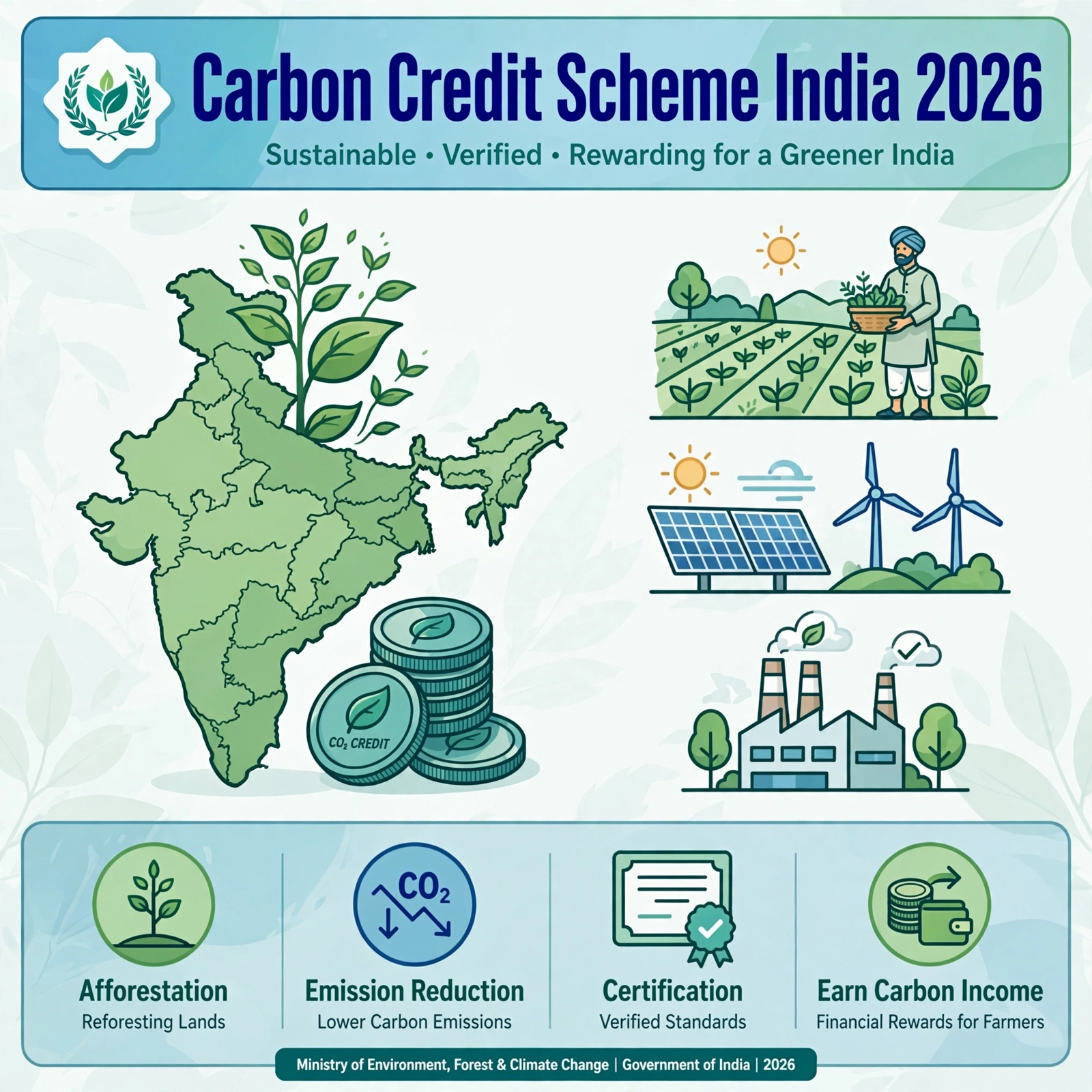
Carbon Credit Scheme in India: Complete Guide
India’s main carbon-market framework is the Carbon Credit Trading Scheme (CCTS), introduced by the Central Government in 2023. It is designed to reduce greenhouse-gas emissions and create a regulated market for Carbon Credit Certificates (CCCs).
What Is the Carbon Credit Scheme?
A carbon credit represents a verified reduction, removal, or avoidance of greenhouse-gas emissions. Under India’s CCTS, eligible projects may receive Carbon Credit Certificates after their emission reductions are measured and independently verified.
The scheme is based on the Energy Conservation Act, 2001, as amended by the Energy Conservation (Amendment) Act, 2022. The Bureau of Energy Efficiency (BEE) acts as the administrator, while the National Steering Committee for Indian Carbon Market provides oversight.[beeindia.gov]
Two Mechanisms Under CCTS
1. Compliance mechanism
This mechanism applies to notified high-emission industries and other obligated entities. These entities receive greenhouse-gas emission-intensity targets.
An obligated entity may need to:
- Reduce emissions to meet its target.
- Earn CCCs by performing better than its target.
- Purchase CCCs if it does not meet the required target.
- Report emissions through the prescribed monitoring system.
The Government has notified emission-intensity targets for sectors such as aluminium, cement, chlor-alkali, fertiliser, iron and steel, and pulp and paper. Additional sectors, including petroleum refineries, petrochemicals, textiles, and secondary aluminium, were notified for inclusion in the compliance mechanism in January 2026.[pib.gov]
2. Offset mechanism
The offset mechanism is intended for non-obligated entities that voluntarily develop projects reducing, removing, or avoiding greenhouse-gas emissions.
Possible participants include:
- Renewable-energy developers.
- Farmer producer organisations.
- Industries outside the compliance system.
- Urban local bodies.
- Forestry and agroforestry projects.
- Waste-management projects.
- Clean-technology companies.
- Agricultural project developers.
BEE states that non-obligated entities can register eligible projects under the offset mechanism and seek issuance of CCCs after fulfilling the required eligibility, monitoring, reporting, and verification conditions.[beeindia.gov]
Sectors Covered
The Government has identified several sectors for project registration under the CCTS offset mechanism:
- Energy.
- Industries.
- Agriculture.
- Waste handling and disposal.
- Forestry.
- Transport.
- Fugitive emissions.
- Construction.
- Solvent use.
- Carbon capture, utilisation and storage.
The exact eligibility depends on the approved methodology and the project’s ability to prove additional, measurable emission reductions.[sansad]
Can Farmers Earn Carbon Credits?
Yes, farmers may participate through eligible agricultural, agroforestry, livestock, or soil-management projects. However, farmers do not automatically receive money simply by planting trees or using organic inputs.
A farmer or farmer group generally needs to:
- Join an eligible carbon project.
- Establish the project’s baseline conditions.
- Follow the approved farming or conservation practices.
- Maintain records of activities and inputs.
- Allow field inspections, remote monitoring, or soil testing where required.
- Complete third-party validation and verification.
- Receive credits only after the reductions or removals are certified.
- Sell the credits through the authorised market process or project aggregator. Carbon Credit Scheme India
Small farmers may find it easier to participate through an FPO, cooperative, NGO, or project developer because measurement and verification costs can be shared.
Examples of Agricultural Projects
Potential agricultural projects may include:
- Improved rice cultivation that reduces methane emissions.
- Livestock and manure-management projects.
- Agroforestry and tree planting.
- Soil-carbon improvement.
- Reduced tillage and residue management.
- Avoiding crop-residue burning.
- Biochar production and application.
- Renewable energy used for farm operations.
- Efficient irrigation and energy-saving equipment.
The project must follow the applicable approved methodology. The public availability of an activity does not by itself guarantee that it will generate CCCs.
How to Apply
There is no single universal “carbon credit application form” for every Indian farmer. The process depends on the project type and the organisation registering it.
Recommended process
- Contact an FPO, agriculture department, Krishi Vigyan Kendra, cooperative society, or verified carbon-project developer.
- Ask for the project’s legal name and approved methodology.
- Confirm whether the project will be registered under India’s CCTS or another voluntary standard.
- Review the participation and revenue-sharing agreement.
- Provide land, crop, bank, and identity documents only through a trusted organisation.
- Confirm who owns the carbon credits.
- Check who pays for monitoring, validation, and verification.
- Obtain written information on the expected payment schedule.
- Keep copies of all forms, agreements, and project records.
The CCTS offset mechanism includes a formal Measurement, Reporting and Verification framework and procedures for accredited carbon-verification agencies.[sansad]
Documents Usually Required
Project developers may request:
- Aadhaar or other identity proof.
- Bank-account details.
- Land ownership documents or valid lease documents.
- Survey number and 7/12 extract where applicable.
- Farm location and geo-coordinates.
- Crop and acreage information.
- Historical farming-practice records.
- Tree-plantation details.
- Consent from co-owners or participating farmers.
- FPO or cooperative membership details.
The exact document list will vary according to the project methodology.
How Much Money Can Farmers Earn?
There is no fixed government rate for one acre or one farmer. Earnings depend on:
- The number of verified credits.
- The market price of the CCCs.
- Project quality and demand.
- Validation and verification costs.
- Aggregator or developer charges.
- The revenue-sharing agreement.
- The permanence and monitoring requirements.
Be cautious of advertisements promising guaranteed income such as “₹50,000 per acre every year.” Ask for a written calculation showing the expected number of credits, current price assumptions, deductions, and the farmer’s final share.
Carbon Credits vs Green Credits
Carbon credits and green credits are related but different.
| Point | Carbon credit | Green credit |
|---|---|---|
| Main purpose | Reduce, remove, or avoid greenhouse-gas emissions | Encourage broader environmental activities |
| Common measurement | Carbon dioxide equivalent | Environmental performance under the relevant programme |
| Examples | Methane reduction, renewable energy, agroforestry | Tree planting, water conservation, waste reduction |
| Indian framework | Carbon Credit Trading Scheme | Green Credit Programme |
| Payment certainty | Depends on verification and sale | Depends on programme rules and credit demand |
Do not assume that receiving a Green Credit automatically means receiving a Carbon Credit Certificate under the CCTS.
Important Fraud Precautions
Before joining a carbon-credit programme:
- Verify the organisation’s registration and physical address.
- Ask for the approved methodology.
- Ask which registry or market will issue the credits.
- Confirm the independent verification agency.
- Read the land-use and credit-ownership clauses.
- Check the project duration and exit conditions.
- Avoid paying a large upfront fee.
- Do not share OTPs, ATM PINs, passwords, or blank signed documents.
- Do not sign away permanent rights over your land without legal advice.
- Obtain a receipt for every payment.
- Ask your FPO, agriculture officer, or lawyer to review the agreement. Carbon Credit Scheme India