
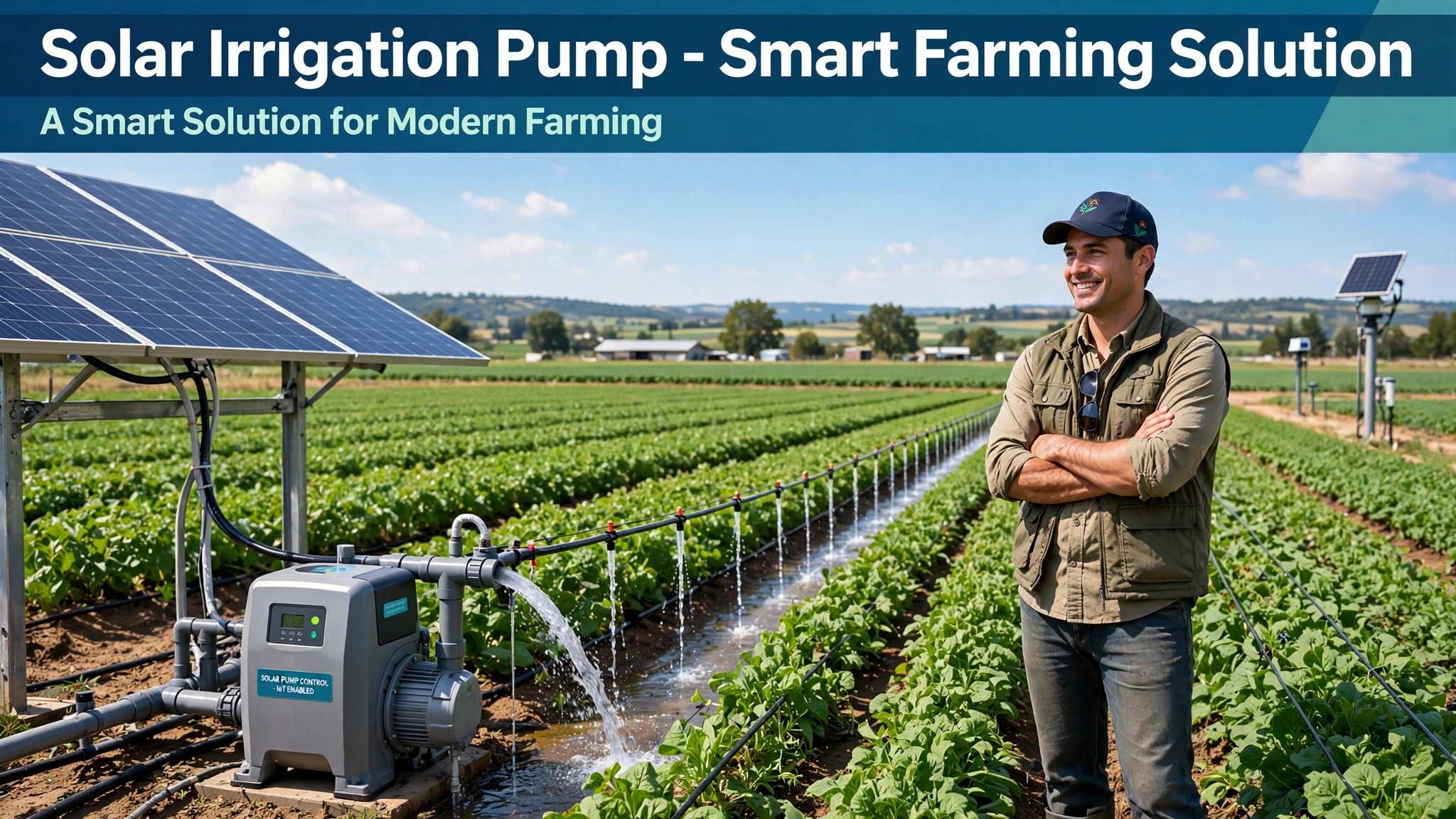
Solar Irrigation Pump: A Smart Solution for Modern Farming
Diesel prices keep rising, the electricity supply to farms is often erratic, and load-shedding can ruin a critical watering window. A solar irrigation pump solves all three problems at once, by drawing power straight from the sun rather than the grid or a diesel tank. Combined with a government subsidy, it is now one of the most practical upgrades a farmer can make. This guide explains how it works, what it costs, and how to apply for the subsidy.
In This Guide
- What is a solar irrigation pump?
- How it works
- Benefits for farmers
- Types of solar pumps and how to size one
- Cost and subsidy under PM-KUSUM
- How to apply online in Maharashtra
- Maintenance tips
- FAQs
What Is a Solar Irrigation Pump?
A solar irrigation pump is a water pump that runs on electricity generated by solar panels instead of the regular power grid or a diesel engine. Solar panels installed near the field or borewell convert sunlight into electricity, which powers the pump motor directly or through a battery, drawing water from a well, borewell, canal or pond straight to the field.
How Does a Solar Irrigation Pump Work?
- Solar panels capture sunlight and convert it into DC electricity.
- A controller/inverter manages this power and, in AC pump systems, converts it to usable current for the motor.
- The pump motor uses this electricity to draw water from the source.
- Water is delivered through pipes to the field, either directly or via a storage tank for later use.
Most systems need no fuel and no grid connection, which is why they work well even in areas where the electricity supply to farms is unreliable. Solar Irrigation Pump: A Smart Solution for Modern Farming
Benefits of Solar Irrigation Pumps for Farmers
- No diesel cost: Once installed, running cost is close to zero, since sunlight is free.
- Works without grid power: Useful in areas with load-shedding or no electricity connection to the field.
- Lower long-term cost: Though upfront cost is higher, the pump pays for itself over a few years through diesel or electricity bill savings.
- Environment-friendly: No emissions, unlike diesel pumps.
- Extra income potential: Under certain components of government schemes, surplus solar power generated can be sold back to the grid.
- Low maintenance: Fewer moving parts than a diesel engine, and panels typically need only periodic cleaning.
Types of Solar Pumps and How to Choose One
| Pump type | Best suited for |
|---|---|
| Submersible solar pump | Borewells, deep water sources |
| Surface solar pump | Ponds, canals, open wells, shallow sources |
| DC solar pump | Smaller capacity, simpler systems, lower cost |
| AC solar pump | Larger capacity, can be paired with grid backup |
Sizing guide (as used in Maharashtra’s Kusum scheme):
| Land holding | Typical pump capacity |
|---|---|
| Up to 1 hectare (up to 2.5 acres) | 3 HP |
| 1.01 to 2 hectares (2.51 to 5 acres) | 5 HP |
| More than 2 hectares (more than 5 acres) | 7.5 HP |
Actual sizing also depends on the depth of your water source and the area you need to irrigate, so it is worth getting a site assessment before ordering.
Cost and Government Subsidy (PM-KUSUM)
A solar irrigation pump is expensive to buy outright, which is exactly why the PM-KUSUM scheme (Pradhan Mantri Kisan Urja Suraksha evam Utthaan Mahabhiyan) exists. Under the central scheme, farmers typically pay only a portion of the cost themselves, with the rest covered by central and state subsidy plus an optional bank loan.
In many states, the subsidy structure works out to roughly 30% central subsidy, 30% state subsidy, and a loan option for part of the remaining cost, leaving the farmer with a relatively small share to pay.
Maharashtra runs its own enhanced scheme, the Mukhyamantri Saur Krishi Pump Yojana, under which eligible farmers have been reported to pay as little as around 5-10% of the cost, depending on category, which is more generous than the general PM-KUSUM subsidy available in many other states.
Because subsidy percentages, farmer categories (general/SC/ST) and scheme windows change from year to year, always check the current rate on the official portal before budgeting for your pump.
How to Apply for a Solar Pump Subsidy in Maharashtra
In Maharashtra, Component B of PM-KUSUM (new standalone solar pumps for off-grid farmers) is implemented by MEDA (Maharashtra Energy Development Agency) under the Maha Krushi Urja Abhiyan, while solarising an existing grid-connected pump is handled through MSEDCL’s Magel Tyala Saur Krushi Pump Yojana.
General steps:
- Go to the official portal. Search for the current MEDA/Mahaurja Kusum portal or MSEDCL’s solar pump portal, and avoid third-party sites that mimic the official one.
- Register with Aadhaar. You will need your Aadhaar number, and in some cases the system checks it is not already registered for the scheme.
- Add your land details. Select your landowner record from the Mahabhumi Abhilekh (land records) portal.
- Choose your pump. Based on your land size and water source, select the recommended pump capacity from the table above.
- Pay the nominal application fee shown on the portal (a small fee, separate from your final beneficiary contribution).
- Wait for site survey and shortlisting. A technician checks your water source and site conditions; allocation depends on your district’s quota.
- Pay your beneficiary share once approved, and an empanelled vendor installs the pump.
Documents typically needed: Aadhaar card, bank passbook, land record (7/12 extract), and a mobile number linked to Aadhaar.
Important: Farmers who already received a solar pump under PM-KUSUM or an earlier scheme within the past several years are generally not eligible to apply again. Always confirm current eligibility, subsidy percentage and the live application link on the official government portal before applying, since scheme details and portals have changed over time.
Maintenance Tips for Solar Irrigation Pumps
- Wipe solar panels clean regularly, since dust reduces power output
- Keep panels free of shade from trees or structures through the day
- Check wiring and connections before each irrigation season
- Get the system inspected by the vendor during the warranty period for any output drop
- Avoid running the pump dry, as it can damage the motor over time
Frequently Asked Questions
1. Is a solar irrigation pump useful even with an existing electricity connection?
Yes. You can solarise an existing grid-connected pump so you rely less on grid power and save on the electricity bill.
2. How much does a solar pump cost without subsidy?
Cost varies by capacity (3 HP, 5 HP, 7.5 HP) and type (submersible/surface, DC/AC); the subsidy is what makes it affordable for most farmers, so always check current market rates from empanelled vendors.
3. Can I sell surplus solar power?
Under certain components of PM-KUSUM, yes, farmers can feed surplus power into the grid and earn additional income, though this depends on the specific component and state rules. Solar Irrigation Pump: A Smart Solution for Modern Farming
4. How long does a solar pump last?
Solar panels commonly carry long warranty periods of over two decades, while pump components may need servicing or replacement sooner; check the vendor’s warranty terms.
5. Where do I apply for the subsidy in Maharashtra?
Through the official MEDA/Mahaurja Kusum portal for a new standalone pump, or MSEDCL’s portal to solarise an existing connected pump.
6. What documents are required?
Aadhaar card, bank passbook, 7/12 land extract, and an Aadhaar-linked mobile number.
Conclusion
A solar irrigation pump cuts your fuel and electricity costs, protects you from power cuts during the irrigation season, and, with the PM-KUSUM and Maharashtra state subsidy, is more affordable than ever. If diesel costs or erratic power supply are hurting your yield, this is one of the smartest upgrades you can make this season. For more practical farming tools and guides, keep visiting KrushiTools.com.
Disclaimer: Subsidy percentages, eligibility criteria, portals and scheme windows mentioned above are based on publicly available information and can change. Verify current details on the official PM-KUSUM (pmkusum.mnre.gov.in) and Maharashtra MEDA/MSEDCL portals before applying.