
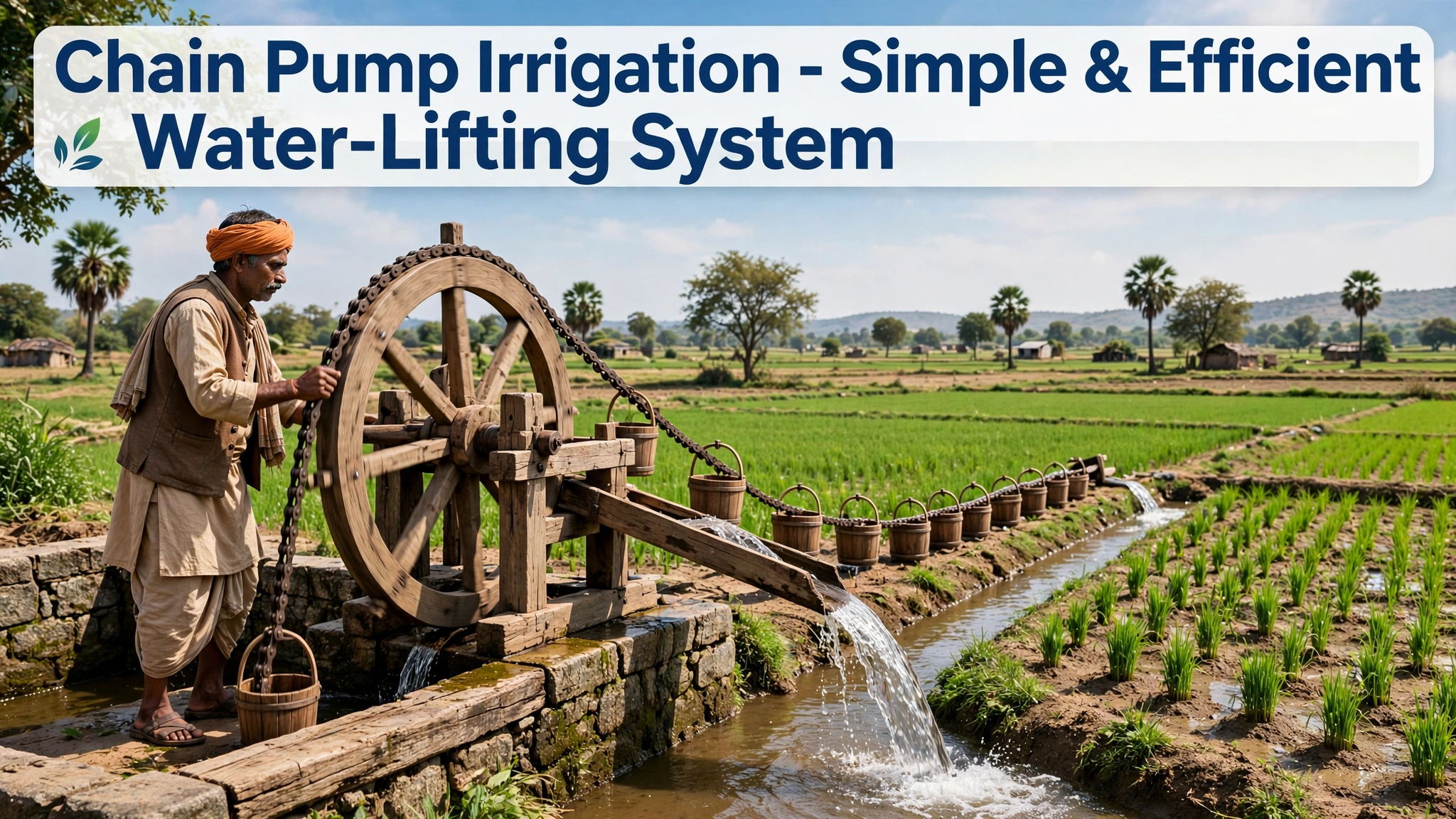
Chain Pump Irrigation: A Simple and Efficient Water-Lifting System
Irrigation is the backbone of successful farming. Throughout agricultural history, farmers have developed ingenious ways to transport water from sources like wells, rivers, and ponds to their crop fields. While modern technology has introduced advanced solar pumps, electric motors, and automated drip systems, understanding traditional mechanisms offers deep insight into agricultural engineering.
One such timeless innovation is the chain pump irrigation system. Known for its mechanical simplicity and reliability, this classic water-lifting technique has helped farmers cultivate crops efficiently for centuries.
In this comprehensive guide, we will explore how chain pump irrigation works, its key components, advantages, and how modern agriculture blends traditional mechanics with contemporary farming equipment available at Krushi Tools.
What is Chain Pump Irrigation?
A chain pump is a type of water-lifting device that uses an endless chain equipped with circular discs or buckets to draw water from a lower source up to a higher level. Chain Pump Irrigation: A Simple and Efficient Water-Lifting System
Historically categorized alongside methods like Moat (pulley system), Rahat (animal-driven wheel), and Dhekli, the chain pump stands out because of its continuous-flow design. It was widely utilized across ancient civilizations in Europe, the Middle East, and China (where it was famously referred to as “dragon backbones”) to irrigate low-lying fields and drain trenches.
How Does a Chain Pump System Work?
The mechanism of a chain pump is straightforward yet highly effective. It relies on basic physical principles and mechanical advantage:
- The Core Components: The system typically consists of two primary wheels (or gears)—one positioned at the top and another submerged halfway into the water source at the bottom.
- The Endless Chain: An endless chain runs continuously around both the upper and lower wheels. Attached to this chain are either small circular discs (that fit snugly inside a vertical pipe) or a series of small buckets.
- Lifting the Water:
- In bucket-based systems, the moving chain dips the buckets into the water source, fills them up, carries them to the top wheel, and tips the water into a delivery chute or pool.
- In disc-and-tube systems, the close-fitting discs pull water upward through a pipe by trapping water in the spaces between the discs, preventing it from slipping back down.
- Continuous Cycle: As long as the top wheel is turned (manually, via animal power, or through a small engine), the chain keeps rotating—raising water continuously.
Key Advantages of Chain Pump Irrigation
Even though high-capacity centrifugal and submersible pumps dominate modern farming, the chain pump model laid the groundwork for mechanical fluid transfer. Its core benefits include:
- Simple Mechanical Design: With fewer complex internal parts than modern electrical turbines, it is relatively easy to understand, build, and repair.
- Steady Water Flow: Unlike single-bucket manual methods, the continuous loop design ensures a steady, uninterrupted flow of water.
- Low Energy Requirements: Historically operated by hand cranks, foot pedals, or livestock, it maximized output while minimizing intense physical labor compared to carrying water manually.
- Effective for Low-Lift Irrigation: It performs exceptionally well when transferring water from shallow wells, irrigation canals, or ditches to adjacent elevated farmlands.
Modern Evolution: From Traditional Pumps to Advanced Agriculture Tools
While traditional chain pumps hold historical value, modern farming demands higher efficiency, automation, and speed to feed a growing population. Today, farmers rely on advanced pumping equipment like petrol/diesel water pumps, heavy-duty agricultural water pumps, and solar irrigation systems to cover large acreage quickly.
If you are looking to upgrade your farm’s irrigation setup or searching for robust machinery, choosing the right tools is essential. At Krushi Tools, you can explore a vast selection of high-performance farming machinery designed to make irrigation and crop management seamless:
- Agricultural Water Pumps: Powerful, fuel-efficient pumps designed for rapid water displacement.
- Power Tillers & Weeders: Essential machinery to prepare your soil beds efficiently before setting up irrigation lines.
- Sprayer & Farm Equipment: Tools to ensure your crops receive optimal hydration and nutrient distribution.
Conclusion
The chain pump irrigation system is a testament to human ingenuity—showcasing how basic mechanics could solve complex agricultural challenges centuries ago. While farming has evolved significantly into an era of motorized pumps and smart irrigation, understanding these foundational concepts helps us appreciate the science of water management.
To boost your farm productivity today, combine smart farming techniques with reliable, heavy-duty equipment. Visit Krushi Tools to browse top-grade agricultural tools, sprayers, pumps, and machinery built for modern farmers!
Frequently Asked Questions (FAQs)
Q1: What is the main purpose of a chain pump in irrigation?
A: A chain pump is used to lift water from a lower water source (like a well, pond, or canal) to a higher elevation or field for crop irrigation.
Q2: Is the chain pump still used in modern agriculture?
A: While largely replaced by motorized, diesel, and solar water pumps for commercial farming, the principle remains a classic example of mechanical water-lifting and is studied widely in agricultural history and science.
Q3: Where can I buy reliable agriculture pumps and tools online?
A: You can find a comprehensive range of high-quality agricultural machinery, water pumps, and garden tools online at Krushi Tools.