
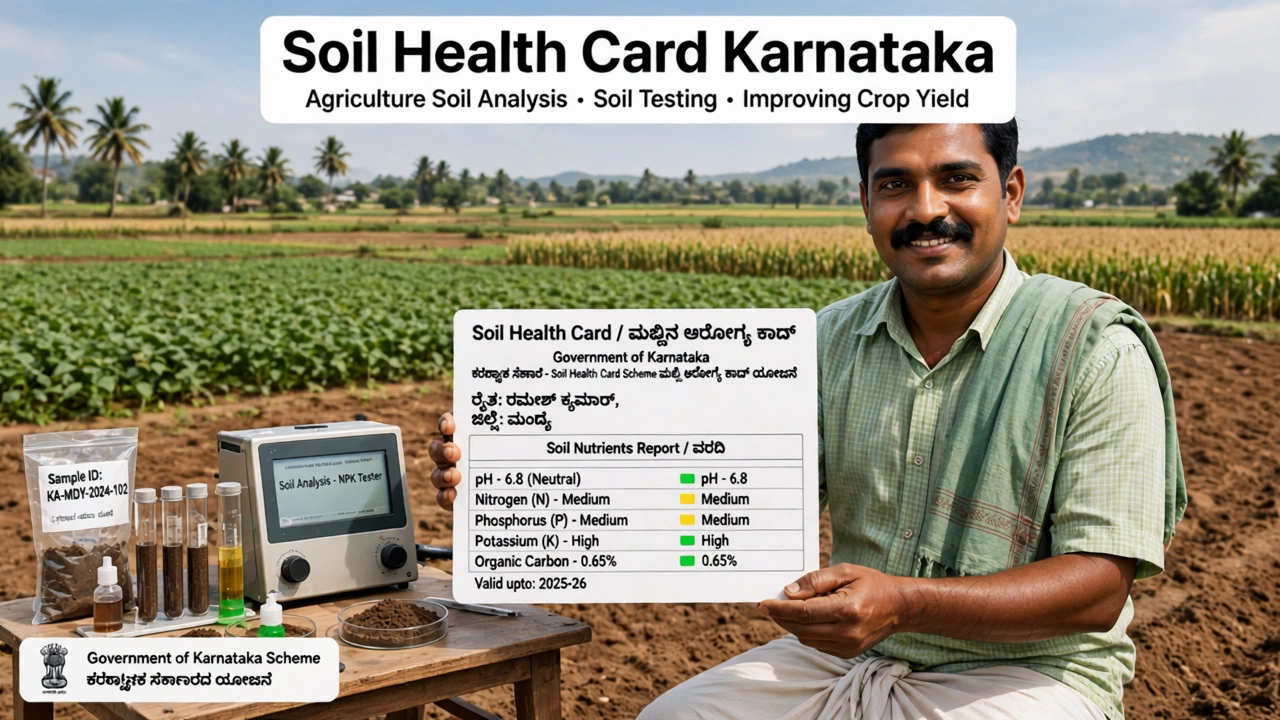
Soil Health Card Karnataka: How to Apply, Check Status & Download
Karnataka farmers grow everything from ragi, paddy and maize to coffee, areca and sugarcane. In all of them, fertiliser is one of the biggest costs. The Soil Health Card (SHC) tells you exactly what your soil has and what it lacks, so you stop guessing. This guide explains how to get your card in Karnataka, how to check its status and how to download it.
What Is a Soil Health Card?
Under the Soil Health & Fertility Scheme, a Soil Health Card gives farmers information on the nutrient status of their soil, along with recommendations on the right dose and type of fertilisers to improve soil health and fertility. The scheme runs as a component of PM-RKVY.
The card is based on soil tested for 12 parameters: pH, EC, organic carbon, nitrogen, phosphorus, potash, sulphur, zinc, iron, copper, manganese and boron. Based on the results, it suggests chemical fertilisers, organic manure and bio-fertilisers for your field.
Soil Health Card in Karnataka: Quick Facts
- Cards issued: Karnataka had 1,76,96,404 soil health cards issued or generated from 2014-15 to 2024-25.
- Who runs it: The state Department of Agriculture handles sampling and testing, with Krishi Vigyan Kendras (KVKs) and universities supporting farmers.
- Cost of the card: The card itself is free for farmers. Check the current norms of the Karnataka Agriculture Department for any sample testing fee, since some guides mention fees.
Benefits for Karnataka Farmers
- Lower fertiliser cost. A National Productivity Council study found that fertiliser use based on SHC recommendations saved 8-10% and raised yields by 5-6%.
- Balanced nutrition. Avoid overusing urea and DAP while the soil is short of zinc, sulphur or potash.
- Better planning. Choose crops and organic inputs that suit your soil.
- Long-term soil health. Repeat cards show how your soil changes over time.
Who Can Apply?
There are very few restrictions. Individual and joint landholders can both apply. You need to be a farmer with a field to test. Keep your Aadhaar card, land details (Survey/Pahani number) and mobile number ready.
How to Get Your Soil Health Card in Karnataka (Step by Step)
Step 1: Contact the right office.
Approach a Krishi Vigyan Kendra (KVK) or your local agriculture office, or contact your village-level agriculture officer. In Karnataka, your nearest Raitha Samparka Kendra is usually the first stop. (Verify the current office and process locally.)
Step 2: Collect the soil sample correctly.
Soil is collected from different parts of the field, when soil moisture is at its lowest. Good sampling practice:
- Walk the field in a zig-zag pattern and take 8-10 small samples.
- Dig a V-shaped pit to about 15-20 cm for most field crops.
- Mix the samples, spread on a clean sheet, and keep about half a kilogram.
- Avoid bunds, trees, compost heaps and wet spots.
- Take separate samples for fields with different soil types or crop history.
Step 3: Fill the information sheet and submit.
Fill out the soil sample information sheet for each sample and enclose it with the soil sample, then submit it and pay any required fee.
Step 4: Wait for testing.
Samples are tested in the department’s soil testing labs. The scheme provides for static, mobile, mini and village-level soil testing labs.
Step 5: Collect or download your card.
You receive a printed card from the local office, or you can download it online (see below).
How to Check Status and Download Your Soil Health Card Online
The official portal is soilhealth.dac.gov.in. Steps generally work like this (screens may change):
- Open soilhealth.dac.gov.in.
- Choose the option to view or print your card or track status.
- Select Karnataka as the state and enter the details the portal asks for, such as farmer or sample details.
- Your card appears on screen and you can download or print it as a PDF.
If the card does not appear, ask your agriculture office whether the sample has been tested and uploaded.
How to Read Your Soil Health Card
| What you see | What it means | What to do |
|---|---|---|
| pH very low or high | Acidic or alkaline soil | Follow amendment advice (lime or gypsum, as recommended) |
| Low organic carbon | Poor soil life and water holding | Add compost, FYM or green manure |
| Low N, P or K | Specific nutrient shortage | Apply only the recommended dose |
| Low zinc, boron, etc. | Micronutrient gap | Apply the micronutrient as advised |
| High nutrient value | Already sufficient | Skip or reduce that fertiliser |
Common Mistakes to Avoid
- Taking a sample from one spot only
- Sampling right after applying fertiliser or manure
- Sending one sample for fields with different soils
- Getting the card but still applying fertiliser “as usual”
- Losing the card. Keep a photo or PDF copy.
Frequently Asked Questions
Q1. Is the Soil Health Card free in Karnataka?
The card is free for farmers under the scheme. Check with the local office about any sample fee.
Q2. How often should I test my soil?
Each farmer gets a card once every two years under the scheme’s cycle. Older notes mention a three-year cycle, so confirm the current norm locally. Test sooner if you change crops drastically.
Q3. Where can I download my card?
From soilhealth.dac.gov.in, or collect a printed copy from your agriculture office.
Q4. Can tenant farmers get a card?
Rules depend on local land records and office practice. Ask your Raitha Samparka Kendra.
Q5. Does the card replace expert advice?
No. Use it with advice from your KVK or agriculture officer, especially for horticulture and plantation crops.
Conclusion
A Soil Health Card turns fertiliser decisions into data. For Karnataka farmers, it is one of the simplest ways to cut costs and protect the soil. Take a proper sample, get it tested, and apply fertilisers as recommended.
📌 Related guides: Soil Health Card Scheme: Benefits, Eligibility, Registration & Download, Soil Health Card Maharashtra, and Higher Production at Lower Cost: 7 Scientific Techniques (add internal links in WordPress).
Disclaimer: This article is for information only. Procedures, offices, fees and cycles can change. Always confirm with the Karnataka Department of Agriculture, your nearest KVK or the official Soil Health Card portal.