
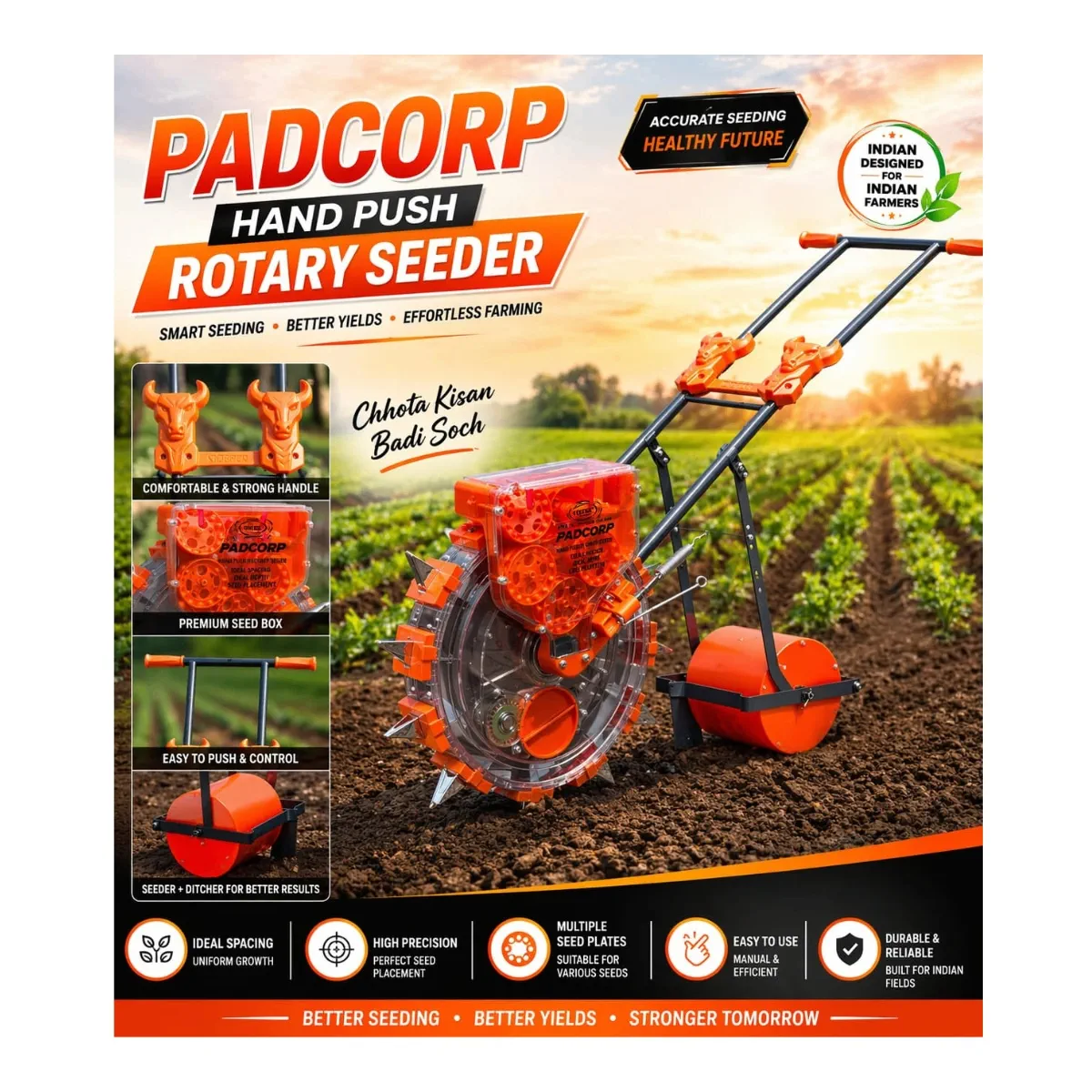
If you’ve been searching for a way to save your back (and your time) during sowing season, you’ve probably stumbled upon the name Pad Corp. Maybe you saw a friend using one, or perhaps you landed on Krushi Tools while looking for multi-crop planters.
Let’s cut to the chase. You’re here because you want one thing: the real price of the Pad Corp Seeder Machine—and whether it’s actually worth that money. Pad Corp Seeder Machine Price.
I’ve spent the last few days digging through specs, talking to small farmers, and comparing costs. Forget the robotic jargon. Here is the honest, human breakdown you need before you make a purchase.
So, What Does the Pad Corp Seeder Actually Cost?
Here is the truth: there isn’t a single “fixed” price. It moves like the monsoon—depending on the model, the attachments, and where you buy it.
 However, based on current listings (including those on Krushi Tools and local dealer networks in 2026), here is the range you should expect:
Basic Manual Model (5-7 rows): ₹12,000 – ₹18,000
Pad Corp Double Bull Series (The popular Lithium 12X16): ₹22,000 – ₹32,000
High-End Multi-Crop with Fertilizer Box: ₹35,000 – ₹45,000
Heads up: The Pad Corp Double Bull Lithium 12X16 is the star of the show right now. It usually sits right in the middle of that range. If you see a price drastically lower than ₹20,000 for a metal-geared model, double-check if it’s a used machine or a plastic-body imitation.
Why the ₹5,000 – ₹10,000 Difference?
When I asked a dealer why two seemingly identical machines had different tags, he laughed. “Bhai, look at the plates.”
Material Matters: The “Lithium” series uses a harder metal alloy for the seed plates. Cheaper models wear out after 2 seasons.
Row spacing: A 12-row seeder costs more than a 9-row seeder. Obvious, right? But many new buyers forget to check this.
The “Extras”: Does it come with 6 extra seed plates (for wheat, mustard, sorghum, etc.)? If yes, you are paying for convenience. That is a good thing.
The Big Question: Is it a “Green” Light or a “Red” Flag?
Let me be real with you. No machine is perfect. Here is what actual users (not just product pages) are saying:
The Good (Why farmers love it)
No more back pain: You literally stand and walk. One farmer told me, “I felt 20 years younger after one season.”
Seed saving: It uses 30-40% less seed than broadcasting. You pay for the machine with that saving alone.
Multi-crop magic: Swap plates in 2 minutes. Wheat today, chickpeas tomorrow.
The Not-So-Good (Be honest with yourself)
Heavy soil struggle: In black clay soil (like parts of MP or Maharashtra), you need two people to push it easily. One person can do it, but you will work up a sweat.
Weed issues: If your field has a lot of stubble or weeds, the wheels can get jammed. You need a relatively clean field.
Where Should You Buy It?
You have two choices, and I recommend a mix of both:
Online (Krushi Tools or similar): Good for price research and seeing models side-by-side. They often offer COD or EMI.
Local Dealer (The better option): Go to a shop in your nearest agricultural market (Krishi Mandi). Ask for a demo. Push the machine on a patch of dry soil. See the seed fall. Then negotiate the price. Often, the local dealer will match the online price and give you free spare plates.
The Final Verdict (Don’t skip this)
If you farm 2 acres or more, buy the Pad Corp Seeder. Specifically, go for the Double Bull Lithium 12X16 if your budget allows. You will recover the ₹25,000 in seed savings and labor within 1-2 seasons.
If you farm less than 1 acre? Honestly? Stick to a simple dibber or a very basic 5-row manual seeder for ₹8,000. The big machine is overkill for a kitchen garden.
Your Next Step:
Head over to Krushi Tools and check their “Seed Cum Fertilizer Drill Machine” section. Compare the Pad Corp side-by-side with a local brand. See the weight difference. Feel the quality in your mind.
Have you used a Pad Corp seeder already? I’d love to hear your real-life experience below. Did you pay more or less? Let’s help the next farmer make a smart choice.