
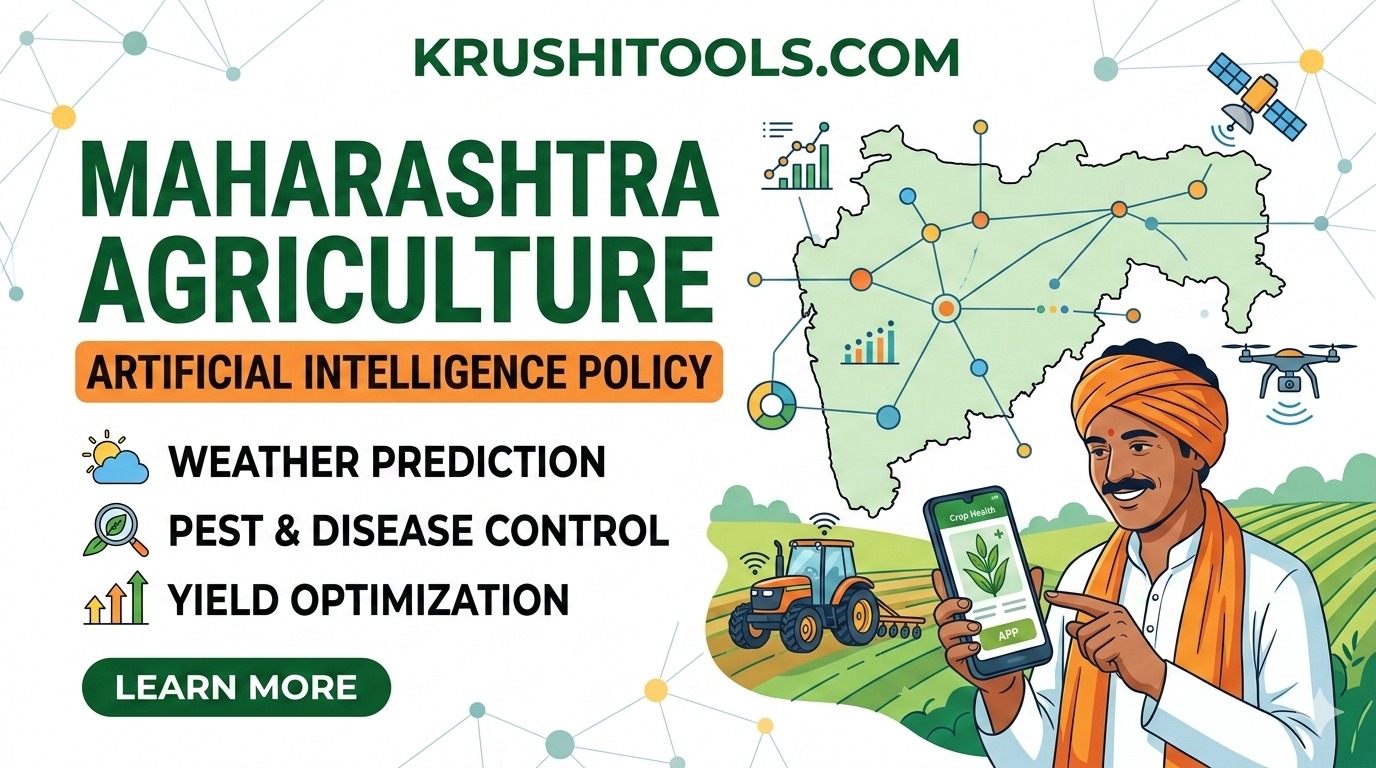
Maharashtra Agriculture AI Policy 2025–2029: MahaAgri-AI, Benefits, Features & Latest Updates
Last Updated: September 2026
The Maharashtra Agriculture AI Policy 2025–2029, officially known as the MahaAgri-AI Policy 2025–2029, is a major initiative of the Government of Maharashtra to bring Artificial Intelligence (AI), Generative AI (GenAI), remote sensing, geospatial technology, data platforms and other emerging technologies into agriculture.
The policy aims to make Maharashtra’s agriculture sector more productive, climate-resilient, technology-driven and farmer-centric.
Through MahaAgri-AI, the Maharashtra Agriculture Department plans to use AI for areas such as crop planning, farm management, pest and disease surveillance, weather and climate risk management, market intelligence, agricultural data, traceability and personalised farmer advisory services.
The policy is designed for the 2025–2029 period and includes an initial proposed allocation of ₹500 crore for implementation.
In this article, let’s understand the MahaAgri-AI Policy 2025–2029, its objectives, key pillars, benefits for farmers, AI technologies, Agriculture Data Exchange, MahaVISTAAR, AI and Agritech Innovation Centre and future opportunities in Maharashtra agriculture.
What Is the Maharashtra Agriculture AI Policy 2025–2029?
The MahaAgri-AI Policy 2025–2029 is a strategic framework created by the Government of Maharashtra’s Agriculture Department to integrate Artificial Intelligence and emerging technologies throughout the agricultural value chain.
The policy focuses on using technology not simply for automation, but for solving practical problems faced by farmers.
These include:
- Climate variability
- Water stress
- Crop productivity
- Pest and disease management
- Rising cultivation costs
- Labour shortages
- Market inefficiencies
- Post-harvest losses
- Supply-chain challenges
- Access to timely agricultural information
The government aims to develop farmer-centric AI solutions that can provide useful information and decision support at the right time.
MahaAgri-AI Policy at a Glance
| Particular | Details |
|---|---|
| Policy Name | MahaAgri-AI Policy 2025–2029 |
| State | Maharashtra |
| Department | Agriculture Department, Government of Maharashtra |
| Main Technology | Artificial Intelligence and Generative AI |
| Policy Period | 2025–2029 |
| Initial Allocation | ₹500 crore |
| Main Focus | Farmer-centric AI and digital agriculture |
| Key Infrastructure | Agriculture Data Exchange, AI Innovation Centres, Remote Sensing |
| Farmer Advisory | MahaVISTAAR and AI-enabled advisory |
| Innovation | Startups, FPOs, universities, NGOs and technology providers |
| Objective | Productivity, resilience and farmer income |
Why Has Maharashtra Introduced an AI Policy for Agriculture?
Agriculture in Maharashtra faces several interconnected challenges.
Farmers often need to make decisions about:
- Which crop to grow
- When to sow
- How much water to use
- Which fertiliser to apply
- How to identify crop diseases
- When to control pests
- Where to sell produce
- How weather may affect production
Traditional knowledge remains extremely important, but modern data and AI can provide additional decision-support tools.
The Maharashtra Government therefore wants to combine agricultural knowledge + data + AI + digital infrastructure to develop more efficient and sustainable farming systems.
Main Objectives of MahaAgri-AI Policy 2025–2029
The policy aims to:
1. Improve Agricultural Productivity
AI can analyse large quantities of agricultural and environmental data to support better farm-management decisions.
2. Increase Farmer Income
Better crop planning, risk management, market information and post-harvest solutions can help improve the economic returns from farming.
3. Strengthen Climate Resilience
AI and geospatial technologies can help identify weather-related and environmental risks and provide early warnings.
4. Promote Sustainable Agriculture
Technology can help farmers use water, fertilisers and other resources more efficiently.
5. Build Digital Agriculture Infrastructure
The policy proposes statewide data and technology infrastructure to support AI-based agricultural applications.
6. Support Innovation
Startups, universities, FPOs, NGOs, research organisations and other innovators can participate in developing farmer-focused solutions.
Key Features of Maharashtra Agriculture AI Policy 2025–2029
The MahaAgri-AI Policy has several important strategic pillars.
1. AI and AgriTech Innovation Centre
The Government of Maharashtra has established the Artificial Intelligence & AgriTech Innovation Centre (AIAIC) as an institutional platform for implementing the state’s agricultural AI vision.
The AIAIC is intended to connect government, startups, researchers, technology companies, FPOs and other stakeholders to accelerate responsible AI adoption in agriculture.
The centre focuses on:
- AI innovation
- Research
- Pilot projects
- Technology implementation
- Startup collaboration
- Data and digital infrastructure
- Scaling successful solutions
2. Maharashtra Agriculture Data Exchange
One of the most important components of the policy is the proposed Maharashtra Agriculture Data Exchange (MahaAgX).
The Agriculture Data Exchange is intended to function as statewide digital public infrastructure that can support agricultural data and AI applications.
It can help bring together relevant agricultural datasets and enable responsible use of data for innovation and decision-making.
Why Is Agricultural Data Important?
AI systems need reliable data.
Agricultural data can include information related to:
- Crops
- Soil
- Weather
- Water
- Satellite imagery
- Farm locations
- Markets
- Production
- Agricultural practices
Better data infrastructure can make AI applications more useful and scalable.
3. AI-Based Remote Sensing and Geospatial Intelligence
The policy proposes an AI-enabled remote sensing and geospatial intelligence engine.
Satellite imagery and geospatial data can help monitor agricultural conditions across large areas.
Potential applications include:
- Crop monitoring
- Crop-area assessment
- Weather-risk analysis
- Drought monitoring
- Water-resource assessment
- Crop stress detection
- Disaster assessment
- Agricultural planning
This is particularly important for a state as geographically diverse as Maharashtra.
4. MahaVISTAAR – AI-Powered Farmer Advisory
Another important component is MahaVISTAAR, which focuses on using Generative AI and emerging technologies for farmer-centric advisory services.
The broader objective is to make agricultural information more accessible, personalised and timely.
AI-powered advisory can potentially assist farmers with questions related to:
- Crop planning
- Pest management
- Disease identification
- Weather
- Cultivation practices
- Market information
- Government agriculture programmes
The Maharashtra Government has highlighted multilingual and personalised advisory, real-time market intelligence, pest surveillance and geospatial early-warning capabilities as part of its farmer-centric AI vision.
5. AI for Crop Disease and Pest Management
Crop diseases and pest attacks can cause significant losses if they are not detected early.
AI can analyse information from:
- Weather data
- Satellite imagery
- Field sensors
- Crop images
- Historical pest patterns
- Geographic information
to help identify potential risks.
Possible benefits
- Earlier detection
- Better pest surveillance
- More targeted interventions
- Reduced unnecessary pesticide use
- Lower crop losses
The objective is not to replace farmers’ knowledge but to provide additional decision-support information.
6. AI for Weather and Climate Risk Management
Weather has a major impact on Maharashtra agriculture.
Unexpected:
- Heavy rainfall
- Drought
- Heat
- Unseasonal rain
- Temperature changes
- Other climate-related events
can affect crop production.
AI and geospatial systems can help analyse weather and environmental information to provide early warnings and risk insights.
This can help farmers make better decisions about sowing, irrigation, crop protection and harvesting.
7. AI for Smart Irrigation and Water Management
Water availability is a major agricultural challenge in many parts of Maharashtra.
AI can combine information such as:
- Soil moisture
- Weather forecasts
- Crop requirements
- Water availability
- Historical conditions
to support more efficient irrigation decisions.
Potential benefits include:
- Reduced water wastage
- Better irrigation scheduling
- Improved crop health
- Efficient use of available water
8. AI for Market Intelligence
Farmers also need reliable information about agricultural markets.
AI can analyse market data and demand patterns to provide useful insights regarding:
- Market trends
- Price movements
- Demand
- Supply
- Selling opportunities
- Commodity trends
This can help farmers make more informed post-harvest marketing decisions.
However, AI-based price predictions should be treated as decision-support information, not guaranteed future prices.
9. AI-Enabled Agri-Food Traceability
The policy also proposes an AI-enabled agri-food traceability and quality certification platform.
Traceability can help track agricultural products through different stages of the value chain.
This can potentially improve:
- Quality assurance
- Food safety
- Supply-chain transparency
- Product authentication
- Market confidence
It can also support better connections between farmers, processors, retailers and consumers.
10. Support for Agriculture Startups and Innovators
The MahaAgri-AI Policy is not limited to government departments.
It also creates opportunities for:
- AgriTech startups
- AI startups
- Universities
- Research institutions
- NGOs
- Farmer Producer Organisations (FPOs)
- Technology companies
- Innovation teams
The official Maharashtra Agriculture Department has invited proposals from innovators for pilot implementation, validation and development of farmer-centric AI solutions.
This can create a larger AgriTech innovation ecosystem in Maharashtra.
₹500 Crore Allocation for Maharashtra Agriculture AI Policy
The MahaAgri-AI Policy includes an initial proposed allocation of ₹500 crore for policy implementation.
The funding is intended to support various components of the programme, including:
- AI and AgriTech Innovation Centre
- Agriculture Data Exchange
- AI innovation and incubation centres
- Remote sensing and geospatial systems
- MahaVISTAAR
- AI-enabled agricultural projects
- Innovation support
- Digital infrastructure
- Capacity building
The policy documents state that additional funding may be made available based on implementation requirements. Maharashtra Agriculture Artificial Intelligence Policy
Benefits of AI in Agriculture for Maharashtra Farmers
The successful implementation of MahaAgri-AI could provide several benefits.
Better Crop Planning
AI can combine weather, soil, crop and market information to support crop-planning decisions.
Early Pest Detection
AI-powered monitoring can help identify potential pest and disease risks earlier.
Better Weather Information
Data-driven forecasting and early-warning systems can help farmers prepare for adverse conditions.
Improved Resource Management
AI can support efficient use of water, fertiliser and other agricultural inputs.
Better Market Information
Market intelligence can help farmers understand demand and price trends.
Reduced Agricultural Risk
Early warnings and data-driven decisions can help farmers manage production risks.
Improved Supply Chains
Digital traceability and AI-based logistics can help reduce inefficiencies and post-harvest losses. Maharashtra Agriculture Artificial Intelligence Policy
Increased Access to Agricultural Knowledge
Generative AI-based advisory tools can make agricultural information easier to access in farmer-friendly formats and languages.
How Will AI Change Farming in Maharashtra?
The future of farming is likely to involve a combination of:
Farmer Experience + Agricultural Science + Data + AI + Digital Technology
For example, a farmer may eventually be able to receive personalised information about: Maharashtra Agriculture Artificial Intelligence Policy
“What crop-management action should I consider today based on my crop, local weather, field conditions and current agricultural risks?”
AI systems can potentially process multiple sources of information and convert them into practical recommendations.
The goal of MahaAgri-AI is therefore not simply to introduce AI technology but to develop farmer-centric digital agriculture solutions at scale.
MahaAgri-AI Policy 2025–2029: Who Can Participate?
The policy ecosystem can involve multiple stakeholders, including:
- Farmers
- Farmer Producer Organisations
- Agriculture universities
- Research institutions
- Startups
- Technology companies
- NGOs
- Government departments
- Investors
- AI researchers
- AgriTech innovators
The Government of Maharashtra’s official programme has specifically invited startups, research institutions, universities, NGOs, FPOs and consortia to participate in innovation opportunities.
Is There a Direct Maharashtra AI Agriculture Scheme for Farmers?
It is important to understand the difference between a policy and a direct individual-benefit scheme.
The MahaAgri-AI Policy 2025–2029 is a strategic framework for transforming agriculture through AI and emerging technologies.
It should not automatically be interpreted as a scheme where every farmer receives a fixed cash benefit for adopting AI.
Instead, the policy creates infrastructure, innovation programmes, advisory systems and technology ecosystems intended to deliver benefits to farmers.
Individual farmer benefits will depend on the specific projects, services and programmes implemented under the policy.
Maharashtra Agriculture AI Policy PDF
Farmers, researchers, startups and other interested readers should refer to the official Maharashtra Agriculture Department and AIAIC resources for the latest policy documents.
The Government’s Agriculture Department provides the MahaAgri-AI Policy 2025–2029 Marathi and English documents, along with information about innovation opportunities and programme activities.
Latest MahaAgri-AI Updates 2026
The Maharashtra Government continues to develop the state’s AI and agriculture ecosystem.
The AI4Agri 2026 platform is connected with the MahaAgri-AI Policy and is designed to bring together governments, researchers, innovators, investors, farmers and development organisations around AI-driven agricultural transformation.
In February 2026, Maharashtra’s leadership also highlighted the importance of moving AI beyond pilot projects and bringing practical AI solutions to farmers, including agriculture data infrastructure and farmer-centric applications.
This indicates that the state’s focus is moving from AI policy creation toward implementation, pilots, ecosystem development and scaling.
MahaAgri-AI Policy vs Traditional Farming
AI does not mean that traditional farming knowledge will become irrelevant.
Instead, the strongest model is likely to combine:
| Traditional Knowledge | AI & Digital Technology |
|---|---|
| Farmer experience | Data analysis |
| Local crop knowledge | Weather intelligence |
| Soil observations | Remote sensing |
| Traditional pest knowledge | AI pest surveillance |
| Local market experience | Market intelligence |
| Field observations | Digital monitoring |
| Agricultural practices | Personalised advisory |
The farmer remains at the centre of decision-making.
Challenges of AI Adoption in Agriculture
Although AI provides major opportunities, implementation also has challenges.
Digital Literacy
Farmers need simple and accessible technology rather than complicated software.
Data Quality
AI recommendations are only as useful as the data behind them.
Internet Connectivity
Reliable digital connectivity is important for real-time agricultural services.
Language
AI tools must support Marathi and other languages commonly used by farmers.
Data Privacy
Agricultural and farmer data needs appropriate security and responsible governance.
Trust
Farmers need to understand how recommendations are generated and how reliable they are.
Last-Mile Adoption
Technology must reach villages and farms—not remain limited to pilot projects.
The Maharashtra policy explicitly emphasises responsible, inclusive and secure AI adoption, including data privacy, algorithmic fairness and environmental sustainability.
Frequently Asked Questions – Maharashtra Agriculture AI Policy
What is MahaAgri-AI Policy 2025–2029?
MahaAgri-AI Policy 2025–2029 is the Government of Maharashtra’s strategic framework for using Artificial Intelligence, Generative AI and emerging technologies across the agricultural value chain.
How much money has Maharashtra allocated for the AI agriculture policy?
The policy documents specify an initial proposed allocation of ₹500 crore for implementation.
What is the main objective of MahaAgri-AI?
The main objective is to use AI and emerging technologies to improve agricultural productivity, climate resilience, farmer incomes and sustainable agricultural development. Maharashtra Agriculture Artificial Intelligence Policy
What is Maharashtra Agriculture Data Exchange?
The proposed MahaAgX is a statewide agriculture data-exchange and sandboxing environment intended to support responsible agricultural innovation and AI applications.
What is MahaVISTAAR?
MahaVISTAAR is a component of the policy focused on using Generative AI and emerging technologies to provide farmer-centric agricultural advisory and information services. Maharashtra Agriculture Artificial Intelligence Policy
What is the AI and Agritech Innovation Centre?
The Artificial Intelligence & AgriTech Innovation Centre (AIAIC) is a Government of Maharashtra platform created to support implementation, innovation, incubation and collaboration under the MahaAgri-AI Policy.
Will every farmer receive money under the MahaAgri-AI Policy?
Not necessarily. MahaAgri-AI is primarily a policy and technology framework. Specific financial benefits will depend on individual projects, programmes and implementation mechanisms.
Can startups participate in MahaAgri-AI?
Yes. The government has created innovation opportunities for startups, research institutions, universities, NGOs, FPOs and other eligible innovators.
Can AI predict crop diseases?
AI can help identify and predict potential pest and disease risks by analysing agricultural, weather, imagery and historical data. It should be treated as decision-support rather than a guaranteed prediction.
Will AI replace farmers?
No. The objective is to provide farmers with better information and decision-support tools. Farmer knowledge and field experience remain essential.
Conclusion: The Future of AI-Powered Agriculture in Maharashtra
The Maharashtra Agriculture AI Policy 2025–2029 represents an important shift toward data-driven and technology-enabled agriculture.
Through MahaAgri-AI, Agriculture Data Exchange, AI-powered remote sensing, MahaVISTAAR, agri-food traceability, innovation support and the AI & Agritech Innovation Centre, Maharashtra is building an ecosystem designed to bring AI closer to agricultural decision-making.
The ultimate success of this policy will depend not only on advanced technology but also on farmer participation, reliable data, local-language services, digital infrastructure, responsible AI governance and successful last-mile implementation.
For Maharashtra’s farmers, the most important question is not simply whether AI is coming to agriculture.
It is:
Can AI provide the right information to the right farmer at the right time?</strong>
If implemented effectively, MahaAgri-AI has the potential to make agriculture more productive, resilient, sustainable and farmer-centric. Maharashtra Agriculture Artificial Intelligence Policy
For the latest Maharashtra agriculture schemes, AI agriculture updates, government schemes and farmer-focused information, bookmark KrushiTools.com and check this page regularly for updates.