
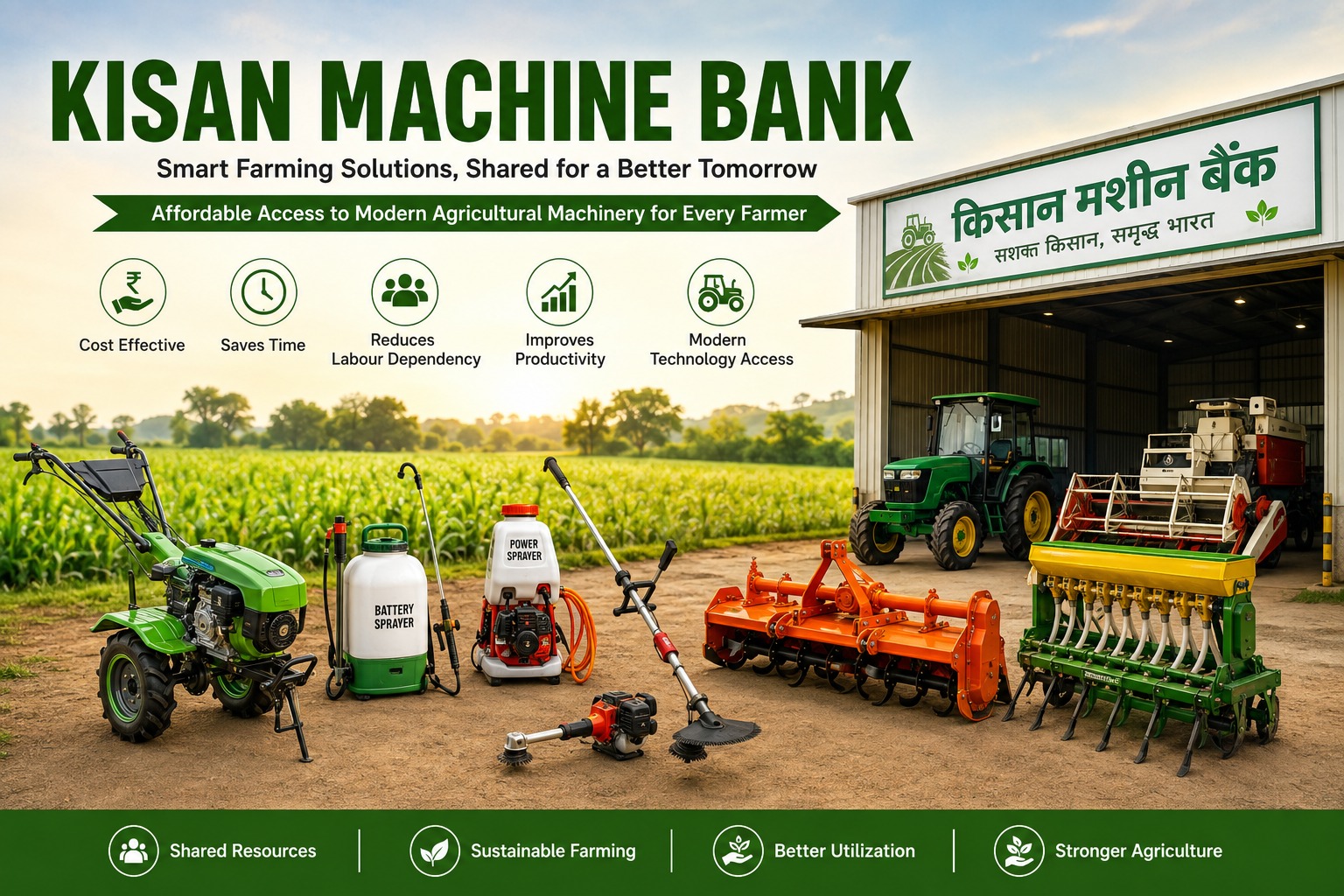
Kisan Machine Bank: A Smart Way to Make Modern Farming Machinery Accessible to Every Farmer
Agriculture is changing rapidly. Today, modern machines can help farmers save time, reduce labour costs, improve productivity, and complete difficult farming operations more efficiently. But there is one major challenge: not every farmer can afford to purchase expensive agricultural machinery.
This is where the concept of a Kisan Machine Bank can make a real difference.
A Kisan Machine Bank is a community-based agricultural machinery service where farmers can access farming equipment on a rental or service basis instead of purchasing every machine themselves. The idea is simple—farmers get access to modern agricultural tools when they need them, without the burden of owning expensive equipment.
For farmers looking for agricultural machinery, farming tools, schemes, and useful agriculture-related information, Krushi Tools provides a dedicated platform covering agricultural products and farming resources. You can explore more at Krushi Tools: https://www.krushitools.com/
What Is a Kisan Machine Bank?
A Kisan Machine Bank is essentially a collection of agricultural machines and equipment maintained for use by farmers in a particular village, group, cooperative, farmer producer organization, or local agricultural enterprise.
Instead of every farmer buying individual machines, the machines can be made available to multiple farmers.
For example, a machine bank may provide equipment such as:
- Power tillers
- Rotavators
- Brush cutters
- Crop cutters
- Agricultural sprayers
- Battery-operated sprayers
- Engine-operated sprayers
- Seeders and planters
- Paddy planting equipment
- Harvesting equipment
- Weeding machines
- Chaff cutters
- Other farm implements
The exact machinery required depends on the crops, farming practices, and requirements of the local farmers.
Why Is the Kisan Machine Bank Important?
Traditional farming often depends heavily on manual labour. During peak agricultural seasons, finding workers can become difficult and labour charges may increase.
At the same time, purchasing a tractor or specialized agricultural machine may require a significant investment.
A machine bank offers another option.
A farmer can access the required equipment for a particular operation and pay according to the applicable rental or service arrangement.
This can help make mechanized farming more accessible, particularly for small and marginal farmers.
Major Benefits of a Kisan Machine Bank
1. Reduces the Cost of Machinery Ownership
Agricultural machinery can be expensive, especially when a machine is needed only for a few days each season.
With a machine bank, farmers can potentially use equipment without purchasing it individually.
This changes the economics from:
“I need to buy this machine.”
to:
“I need access to this machine when required.”
2. Saves Time
Modern agricultural machinery can complete certain farming operations much faster than manual labour.
This is especially useful during time-sensitive activities such as:
- Land preparation
- Sowing
- Spraying
- Weeding
- Harvesting
- Crop residue management
Finishing these operations at the right time can be extremely important for farm management.
3. Helps Address Labour Shortages
Labour availability can fluctuate significantly during agricultural seasons.
A machine bank can provide farmers with an alternative when sufficient agricultural workers are not available.
Rather than waiting for labour, farmers may be able to book appropriate machinery for the required operation.
4. Encourages Farm Mechanization
Mechanization is not only about owning large machines.
It is also about making appropriate technology available to farmers.
A machine bank can encourage farmers to adopt useful equipment such as power tillers, sprayers, cutters, weeders, and other agricultural implements.
5. Better Utilization of Machinery
A privately owned machine may remain unused for long periods.
A community machine bank can improve utilization because the same equipment can serve multiple farmers during different time slots.
This can make the investment more productive.
How Does a Kisan Machine Bank Work?
The basic operation can be simple.
Step 1: Identify Local Farming Requirements
First, the organization should identify the major crops and farming activities in the area.
For example, a rice-growing region may require different machinery from a cotton-growing or horticulture-focused region.
Step 2: Select Appropriate Machines
Based on local requirements, the machine bank can acquire suitable agricultural equipment.
The focus should be on machines that have regular demand rather than purchasing equipment that will remain unused.
Step 3: Maintain a Machine Inventory
Every machine should have proper records, including:
- Machine name
- Brand/model
- Purchase date
- Maintenance history
- Operating condition
- Rental/service rate
- Availability
- Current user
- Fuel or battery requirements
Step 4: Create a Booking System
Farmers should be able to request machines easily.
A simple system can begin with a register or telephone/WhatsApp booking process. A larger machine bank can eventually use an online booking and management system.
Step 5: Provide the Machine or Operator
Depending on the equipment, the machine bank can provide either:
Machine only, where the farmer operates it, or
Machine + operator, where a trained operator performs the agricultural work.
For complicated machinery, providing a trained operator can improve safety and machine utilization.

Step 6: Maintenance and Service
Regular maintenance is essential.
Machines should be inspected after use and serviced according to manufacturer recommendations.
Good maintenance helps reduce breakdowns and increases the useful life of equipment.
Who Can Start a Kisan Machine Bank?
A machine bank can potentially be organized by different types of agricultural groups or organizations, depending on the applicable local rules and funding structure.
Possible operators include:
- Farmer groups
- Farmer Producer Organizations (FPOs)
- Agricultural cooperatives
- Self-help groups
- Rural entrepreneurs
- Agricultural service providers
- NGOs
- Local institutions
- Agricultural machinery businesses
The most important requirement is a sustainable operating model that ensures farmers can access machinery while the equipment remains financially viable.
What Machines Should Be Included?
There is no universal machine list for every location.
The right equipment should be selected according to local demand.
For example, a machine bank serving vegetable farmers may benefit from sprayers, tillers, weeders, and small agricultural implements.
A region dominated by cereal crops may have greater demand for planting, harvesting, threshing, and crop-processing equipment.
Some commonly useful categories include:
Soil Preparation:
Power tillers, cultivators, rotavators, and related implements.
Crop Protection:
Battery-operated sprayers, engine-operated sprayers, hand sprayers, and spraying accessories.
Weeding & Cutting:
Brush cutters, crop cutters, weeders, and similar equipment.
Planting:
Seeders, planters, and crop-specific planting machinery.
Harvesting:
Crop-specific harvesting and threshing equipment.
Krushi Tools covers several agricultural machinery and equipment categories, including crop cutters, cotton picking machines, lawn mowers, fogging machines, battery sprayers, engine-operated sprayers, hand-operated sprayers, and other farming tools.
Kisan Machine Bank Business Model
A machine bank can also become a rural business opportunity when managed professionally.
The basic model can be:
Machine Investment → Farmer Booking → Machinery Service → Rental/Service Income → Maintenance → Continued Operation
Revenue may come from:
- Hourly machine rental
- Daily machine rental
- Per-acre service charges
- Machine + operator services
- Seasonal packages
- Custom agricultural services
For example, instead of charging farmers only for possession of a machine, a service provider may charge according to the agricultural work completed.

A per-acre service model can be particularly convenient because farmers know the approximate cost of completing a specific farming operation.
Important Things to Consider Before Starting
Starting a machine bank requires more than purchasing equipment.
Demand Analysis
Before buying a machine, determine how frequently farmers will need it.
Machine Selection
Choose reliable equipment appropriate for local crops and field conditions.
Operator Training
Operators should understand proper machine operation and basic safety procedures.
Maintenance
Create a preventive maintenance schedule instead of waiting for machines to break down.
Booking Management
Maintain clear records of bookings, payments, machine usage, and availability.
Financial Planning
Calculate:
- Purchase cost
- Financing cost
- Fuel
- Maintenance
- Operator wages
- Insurance or applicable expenses
- Storage
- Depreciation
- Expected rental income
A proper calculation helps determine whether the machine bank can operate sustainably.
Technology Can Make Machine Banks Even Better
A modern Kisan Machine Bank does not have to depend entirely on paper records.
Technology can help manage the entire operation.
A digital system could include:
- Farmer registration
- Machine inventory
- Online booking
- Rental management
- Payment tracking
- Machine availability
- Operator management
- Maintenance reminders
- Service history
- Reports
- SMS/WhatsApp notifications
This can make the machine bank more transparent and easier to manage as the number of farmers increases.
Kisan Machine Bank and the Future of Farming
The future of agriculture is likely to involve a combination of mechanization, technology, better resource utilization, and collaborative farming services.
Not every farmer needs to own every machine.
What farmers need is reliable access to the right machine at the right time and at a reasonable cost.
That is the real strength of the Kisan Machine Bank model.
By sharing agricultural machinery, farmers can potentially reduce individual investment, access modern equipment, overcome seasonal labour challenges, and improve the efficiency of farming operations.
Final Thoughts
A Kisan Machine Bank can be more than just a collection of agricultural machines. It can become an important rural service infrastructure that connects farmers with modern technology.
For small and medium farmers especially, access can sometimes be more valuable than ownership.
With proper planning, machine selection, maintenance, transparent pricing, trained operators, and digital management, a machine bank can create benefits for both farmers and the organization operating it.
As Indian agriculture continues moving toward greater mechanization, models like Kisan Machine Banks can play an important role in making modern farming technology more accessible at the grassroots level.
Looking for agricultural machinery, farming tools, and agriculture-related information? Visit Krushi Tools to explore agricultural products and resources: https://www.krushitools.com/
Frequently Asked Questions
What is a Kisan Machine Bank?
A Kisan Machine Bank is a shared agricultural machinery facility that allows farmers to access farming equipment through rental or agricultural services rather than purchasing every machine individually.
Who can use a Kisan Machine Bank?
Farmers in the service area can use the machinery according to the machine bank’s booking, rental, and usage policies.
What machines can be included?
Depending on local requirements, a machine bank may include power tillers, sprayers, brush cutters, crop cutters, planters, weeders, harvesting equipment, and other agricultural machinery.
Can a Kisan Machine Bank become a business?
Yes. With proper demand analysis, pricing, machine utilization, maintenance, and financial management, agricultural machinery rental and custom hiring can form a rural business model.
Where can I find agricultural tools and machinery?
You can explore agricultural tools, machinery, and related farming resources on Krushi Tools at https://www.krushitools.com/.