
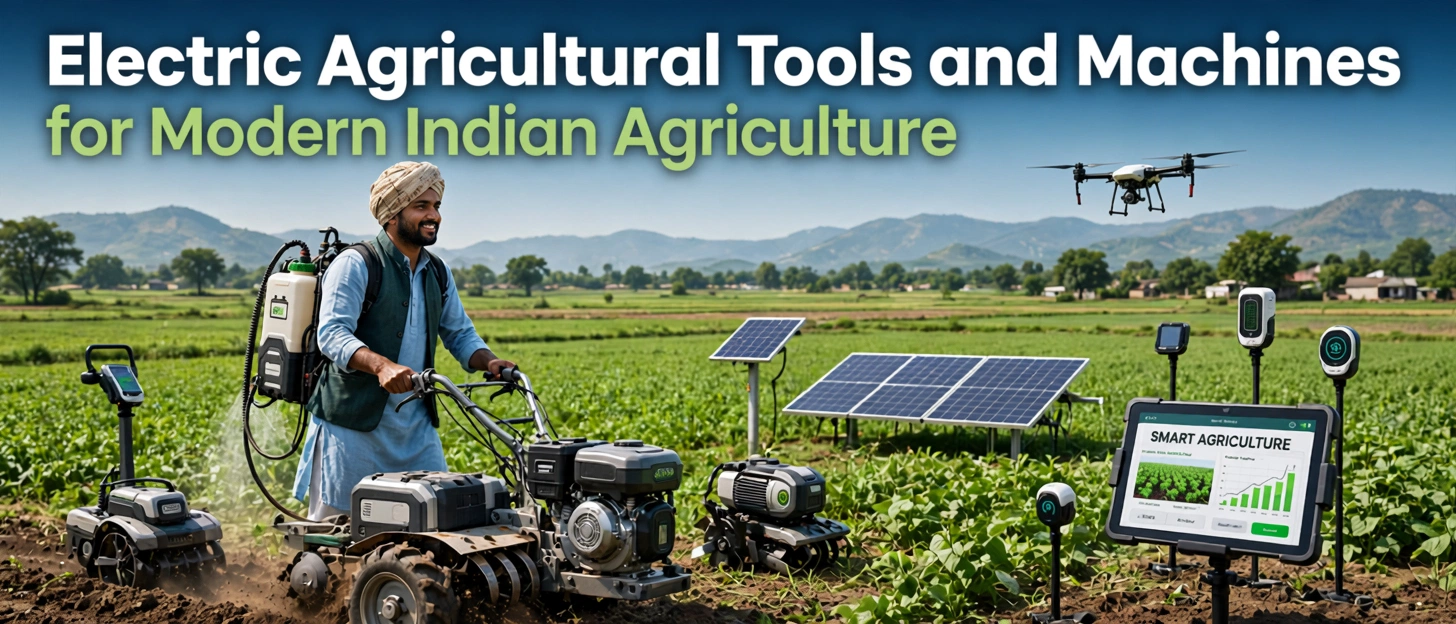
Electric Agricultural Tools and Machines for Modern Indian Agriculture
Indian agriculture is rapidly evolving with the introduction of modern farming technology, advanced machinery and energy-efficient equipment. Farmers are increasingly exploring electric agricultural tools and machines to reduce manual effort, improve farm operations and manage cultivation costs.
From battery-operated agricultural sprayers and electric power weeders to solar-powered irrigation systems and emerging electric tractors, modern equipment is creating new opportunities for small, medium and large-scale farmers.
Traditional farming equipment often requires manual labour, diesel engines or continuous physical effort. Electric agricultural machinery offers alternatives for selected farming operations by using rechargeable batteries, electric motors or electricity generated through solar power.
For Indian farmers, choosing the right machinery depends on land size, crop type, soil conditions, electricity availability, equipment cost and after-sales service.
In this guide, we explore the different types of electric agricultural tools and machines for modern Indian agriculture, their applications, advantages, limitations, buying considerations and government support options.
What Are Electric Agricultural Tools and Machines?
Electric agricultural tools and machines are farming equipment powered by electricity instead of relying entirely on manual operation or conventional fuel-powered engines.
Depending on the machine, electricity may come from:
- Rechargeable battery packs.
- Direct electricity supply.
- Solar-powered electricity systems.
- Battery systems combined with solar charging.
These machines are designed for different farming operations, including spraying, weeding, cutting, irrigation, sowing, harvesting and post-harvest processing.
Electric agricultural equipment can be particularly useful for horticulture, vegetable cultivation, orchards, vineyards, nurseries and selected small-farm operations.
However, not every electric machine can replace a diesel tractor or large agricultural implement. Farmers should select machinery according to their actual field requirements.
1. Battery Operated Agricultural Sprayer
Battery-operated agricultural sprayers are among the most practical electric tools used on Indian farms.
Traditional manual knapsack sprayers require continuous hand pumping. Battery-operated sprayers use rechargeable batteries to power an electric pump, which delivers liquid through the hose and spray nozzle.
Main Features
- Rechargeable battery.
- Electric pumping system.
- Portable tank design.
- Adjustable spray nozzles, depending on the model.
- Rechargeable or replaceable battery options.
- Reduced manual pumping effort.
Applications
Battery-operated sprayers can be used for:
- Cotton farms.
- Soybean cultivation.
- Vegetable crops.
- Fruit orchards.
- Flower cultivation.
- Nurseries.
- Selected horticultural applications.
Buying Considerations
Before buying a battery sprayer, check:
- Tank capacity in litres.
- Battery voltage and ampere-hour rating.
- Expected operating time under actual spraying conditions.
- Charging time.
- Pump pressure and flow rate.
- Nozzle quality and availability.
- Battery replacement cost.
- Warranty and local service support.
The actual spraying area per charge depends on crop height, nozzle type, pressure, walking speed and operating conditions. Do not rely only on advertised coverage figures.
2. Electric Power Weeder and Agricultural Weeding Machines
Weeding is an important farming operation. Unwanted weeds compete with crops for water, nutrients, sunlight and growing space.
Electric power weeders use an electric motor to drive rotating blades or suitable weeding attachments.
Battery-operated and other electrically driven weeding machines can reduce manual effort in suitable field conditions.
Benefits of Electric Power Weeders
- Reduced physical effort.
- Convenient operation in selected crop rows.
- No direct exhaust emissions during battery-powered operation.
- Potentially lower noise than comparable fuel-powered equipment.
- Useful for selected horticultural and small-field applications.
Suitable Applications
| Crop | Possible machine application |
|---|---|
| Soybean | Inter-row weeding |
| Cotton | Weed control between crop rows |
| Vegetables | Row cultivation |
| Orchards | Weed management |
| Fruit plantations | Selected inter-row operations |
| Nurseries | Light soil cultivation |
What to Check Before Buying
Look for the following specifications:
- Motor power in watts.
- Working width.
- Blade design.
- Working depth.
- Battery capacity.
- Runtime under field load.
- Soil suitability.
- Machine weight.
- Availability of replacement blades.
A machine suitable for dry, loose soil may not work equally well in wet, compact soil or heavy vegetation. Always request a practical field demonstration.
3. Electric Brush Cutters and Grass Cutting Machines
Electric brush cutters are useful for clearing grass, weeds and selected unwanted vegetation around agricultural fields.
Battery-powered brush cutters use an electric motor to operate a rotating cutting attachment.
Applications
- Field boundary maintenance.
- Orchard grass management.
- Vegetable farm maintenance.
- Nursery maintenance.
- Grass cutting.
- Selected crop-residue and vegetation management tasks.
Important Features
- Motor power.
- Battery voltage.
- Cutting attachment type.
- Operating time.
- Machine weight.
- Handle and harness design.
- Safety guard.
- Blade availability.
Choose the cutting head and blade according to the manufacturer’s intended use. Do not fit incompatible blades or remove safety guards.
4. Electric Agricultural Tractors
Electric tractors are an emerging area of agricultural mechanization in India.
Unlike diesel tractors, electric tractors use battery-powered electric motors for propulsion and other supported agricultural operations.
They may be suitable for selected applications such as:
- Orchard operations.
- Light and medium farm transport.
- Selected cultivation operations.
- Farmyard and agricultural handling.
- Repetitive operations where charging and operating schedules can be planned.
Advantages of Electric Tractors
1. Reduced direct emissions
Battery-powered electric tractors produce no tailpipe exhaust while operating.
2. Lower operating noise
Electric motors can operate more quietly than conventional diesel engines under comparable operating conditions.
3. Different maintenance requirements
Electric drive systems have fewer moving engine components than conventional diesel engines, although batteries, power electronics, motors, cooling systems and other components still require maintenance.
4. Instant electric motor response
Electric motors can provide strong low-speed torque, depending on the motor and controller design.
5. Potential operating-cost savings
Operating costs may be lower in suitable applications, but savings depend on electricity tariffs, diesel prices, equipment utilization, battery replacement, purchase price and service costs.
Electric Tractor Market in India
Electric tractors remain an emerging segment rather than a complete replacement for diesel tractors.
A November 8, 2026 Business Standard report, citing VAHAN data, reported 248 electric tractor registrations between January 1 and October 31, 2026.
This illustrates the early stage of market adoption.
India introduced IS 19262:2025, an Indian Standard test code for electric agricultural tractors. It covers testing such as PTO power, drawbar power, vibration and specification verification.
Farmers should ask manufacturers for relevant approved testing or homologation documents and verify the exact model’s suitability for the intended work.
5. Electric Seeders and Precision Sowing Machines
Electric-powered agricultural equipment can also support sowing and planting operations.
Depending on the design, electric motors may operate seed-metering mechanisms, fertilizer applicators or multipurpose agricultural tool bars.
Applications
- Vegetable seed sowing.
- Precision seed placement.
- Seed and fertilizer distribution.
- Selected inter-row planting operations.
- Nursery and horticultural applications.
Benefits
- More controlled operation.
- Reduced repetitive manual effort.
- Potentially more consistent seed placement when properly calibrated.
- Support for selected small-farm mechanization operations.
Important Selection Factors
Check seed compatibility, row spacing, sowing depth, seed-metering accuracy, motor power, battery runtime and machine calibration.
The same machine may not be suitable for all crop types or seed sizes.
6. Electric Irrigation Pumps and Solar Agriculture Pumps
Water management is one of the most important parts of Indian agriculture.
Electric irrigation pumps use an electric motor to move water from a source to the irrigation system.
Solar agricultural pumps use solar panels to generate electricity for operating a pump. Some systems also include batteries, while others use solar power directly with suitable controllers.
Applications
- Drip irrigation.
- Sprinkler irrigation.
- Farm ponds.
- Water transfer.
- Small irrigation systems.
- Horticultural farms.
Advantages
- Reduced dependence on diesel pumping.
- Suitable for farms with reliable electricity or solar generation.
- Can support scheduled irrigation.
- Useful in selected remote agricultural locations.
How to Choose an Agricultural Pump
Before buying a pump, evaluate:
| Specification | Why it matters |
|---|---|
| Pump capacity | Water delivery requirement |
| Head | Vertical lift and pumping pressure |
| Flow rate | Water delivered per hour |
| Motor rating | Required electrical power |
| Energy source | Grid, battery or solar |
| Pipe diameter | Water-flow suitability |
| Water source | Borewell, open well or pond |
| Service support | Repair and spare parts |
Pump capacity should be designed according to the water requirement, total head and irrigation system. Do not choose a pump only by its horsepower.
7. Electric Chaff Cutters and Agricultural Processing Machines
Electric chaff cutters are used for chopping fodder for livestock.
Other electric-motor-driven post-harvest equipment includes suitable grain cleaners, small flour mills, feed-processing machines and selected crop-processing units.
Main Benefits
- Reduced manual cutting work.
- More consistent machine-driven operations.
- Improved handling of fodder and agricultural materials.
- Useful for dairy farms and livestock operations.
- Can support small agricultural processing businesses.
Applications
- Dairy farming.
- Cattle and buffalo farms.
- Goat farming.
- Fodder processing.
- Small agricultural enterprises.
Before purchasing a chaff cutter, check cutting capacity, motor power, blade quality, safety guards and the availability of spare parts.
8. Multi-Purpose Electric Agricultural Tools
Some manufacturers and agricultural technology developers are working on multipurpose electric machines.
These platforms may support interchangeable attachments for:
- Weeding.
- Cutting.
- Spraying.
- Sowing.
- Small-scale soil preparation.
- Selected harvesting operations.
ICAR research has also explored battery-powered multipurpose agricultural equipment for small farmers, including electric prime-mover systems with interchangeable attachments.
The key advantage is that a farmer may be able to use one power unit for multiple operations rather than purchasing separate machines for every task.
However, before buying, check whether the attachments are genuinely compatible and whether their performance has been tested for your crop and soil conditions.
9. Electric Agricultural Tools vs Diesel Agricultural Machines
Electric and diesel machines are suitable for different applications.
| Feature | Electric equipment | Diesel equipment |
|---|---|---|
| Energy source | Battery or electricity | Diesel fuel |
| Local operating emissions | No tailpipe emissions for battery machines | Exhaust emissions |
| Operating noise | Often lower | Generally higher |
| Maintenance | Motor, battery and electronics | Engine, fuel and transmission systems |
| Operating duration | Depends on battery or power supply | Depends on fuel availability |
| Refuelling / charging | Charging required | Diesel refuelling |
| Initial cost | Varies by machine | Varies by machine |
| Heavy-duty applications | Model-dependent | Established availability across many categories |
Electric machinery is not automatically cheaper or better for every farm.
The best choice depends on annual usage, charging access, crop requirements, operating conditions, purchase price and the availability of local service.
10. Benefits of Electric Agricultural Tools for Indian Farmers
1. Reduction in manual labour
Electric machines can reduce repeated physical effort in tasks such as spraying, weeding and cutting.
2. Improved operating convenience
Rechargeable equipment can make selected farm operations easier to schedule.
3. Lower local noise
Many battery-operated tools produce less operating noise than comparable small petrol engines.
4. No direct exhaust from battery-powered machines
Battery-powered equipment produces no tailpipe exhaust at the place of operation.
Its overall environmental impact still depends on electricity generation, battery manufacturing, battery life and recycling.
5. Suitable for selected small and medium farms
Portable equipment can be useful where large machinery is unsuitable or uneconomical.
6. Potential savings in recurring expenses
The economic benefit depends on purchase price, electricity cost, battery replacement and actual hours of use.
7. New opportunities for agricultural entrepreneurs
Electric machinery can create opportunities for agriculture equipment dealerships, machinery rental centres and farm service businesses.
11. How to Select the Right Electric Agricultural Machine
Farmers should not purchase electric equipment only because it uses modern technology.
The machine must solve an actual farming problem.
Follow this checklist:
A. Identify your farming operation
Decide whether you need a sprayer, weeder, brush cutter, irrigation pump, tractor or processing machine.
B. Check land size
A small battery-operated tool may be sufficient for a small vegetable farm, while larger cultivation operations may require a tractor-mounted or higher-capacity machine.
C. Evaluate crop type
Different crops require different machinery, cutting widths and working methods.
D. Compare motor power
Check the rated motor output and performance under actual field conditions.
E. Check battery specifications
Evaluate battery voltage, ampere-hour rating, charging time, expected runtime and replacement cost.
F. Verify performance
Ask for a field demonstration rather than relying only on advertisements.
G. Check service and spare parts
Confirm that batteries, chargers, controllers, motors, blades, pumps and other parts are available locally.
H. Compare total ownership cost
Include the purchase price, electricity, maintenance, battery replacement, transportation and expected resale value.
12. Are Electric Agricultural Machines Eligible for Government Subsidy in India?
Government support for agricultural mechanization is available through various central and state programmes.
However, not every electric machine automatically qualifies for a subsidy.
The Sub-Mission on Agricultural Mechanization (SMAM) supports eligible agricultural machinery purchases and Custom Hiring Centres through state governments.
Under the published national policy, financial assistance rates and conditions depend on the category and type of project.
Electric agricultural equipment on MahaDBT Maharashtra
The Maharashtra MahaDBT Farmer User Manual includes a component called:
Self Propelled Electric Agricultural Tool Bar
This is an important development for farmers interested in electric farm machinery.
However, the appearance of this component in the manual does not guarantee that every applicant can currently select it or receive a subsidy. Eligibility, component availability, approved specifications, project cost and available funding must be confirmed on the live portal.
Documents commonly required under farm mechanization schemes
- Aadhaar Card.
- Farmer ID, where required.
- 7/12 extract.
- 8-A extract.
- Machinery quotation.
- Testing certificate from the approved agency, where applicable.
- Caste certificate for eligible SC/ST applicants.
- Self-declaration.
- Pre-sanction approval.
Important: Obtain the required pre-sanction approval before purchasing equipment. Follow the current scheme instructions.
Official subsidy portals
MahaDBT Maharashtra:
https://mahadbt.maharashtra.gov.in/Farmer/AgriLogin/AgriLogin
Agricultural Mechanization:
https://agrimachinery.nic.in/
Ministry of Agriculture:
https://agriwelfare.gov.in/
13. How to Calculate the Cost and Savings of Electric Farm Machinery
Before buying a machine, compare the total cost of ownership rather than only the initial purchase price.
Consider this example:
A farmer is comparing a battery-operated sprayer with a conventional fuel-powered spraying machine.
The comparison should include:
- Purchase cost.
- Electricity or fuel cost.
- Annual maintenance.
- Battery replacement, if applicable.
- Number of operating hours per year.
- Area covered per operating hour.
- Expected useful life.
- Resale value.
Simple cost calculation
Cost per operating hour:
(Total annual ownership cost + annual running cost) ÷ Annual operating hours.
For battery equipment, calculate the cost of charging using the actual electricity consumption in kWh and the applicable electricity tariff.
For example, a 48-volt, 20-Ah battery has a nominal energy capacity of approximately 0.96 kWh. The usable energy will be lower or may vary depending on battery chemistry, discharge limits and operating conditions.
Use the manufacturer’s tested runtime and the actual field workload when calculating savings.
14. Safety and Maintenance Tips for Electric Agricultural Equipment
Proper maintenance improves equipment reliability and helps protect operators.
Follow these precautions:
- Read the manufacturer’s operating instructions.
- Charge batteries using the recommended charger.
- Avoid charging damaged or wet battery packs.
- Protect electrical connections from water and chemicals.
- Inspect cables, connectors and switches regularly.
- Keep blades and moving components guarded.
- Disconnect power before servicing.
- Use recommended protective equipment.
- Do not operate machines beyond their specified load.
- Store batteries according to the manufacturer’s instructions.
Safety while using battery sprayers
When spraying pesticides or other agricultural chemicals:
- Read the pesticide label and follow its instructions.
- Wear the recommended protective equipment.
- Check hoses, pumps and nozzles for leakage.
- Apply chemicals at the recommended dosage.
- Avoid spraying in unsafe wind conditions.
- Keep children, livestock and other people away from the spray area.
- Never clear blocked nozzles by blowing through them with your mouth.
- Clean and maintain the equipment safely after use.
Electric power does not remove the chemical hazards associated with pesticide spraying.
15. Future of Electric Agricultural Machinery in India
Electric farm machinery is likely to become an increasingly important part of modern agricultural mechanization.
Potential developments include:
- More affordable battery-operated equipment.
- Improved battery life and charging systems.
- Multipurpose electric farm platforms.
- Electric tractors for suitable applications.
- Solar-powered irrigation solutions.
- Sensor-based spraying equipment.
- Precision farming systems.
- Better battery servicing and recycling networks.
The development of IS 19262:2025 for electric agricultural tractor testing is an important step in establishing a common technical testing framework.
As technology improves and service networks expand, electric machinery may become suitable for more agricultural operations.
However, farmers should evaluate each machine on its specifications, performance and economics rather than assuming every new electric product will be suitable for every farm.
Frequently Asked Questions – Electric Agricultural Tools and Machines
1. What are electric agricultural tools?
Electric agricultural tools are farming machines powered by rechargeable batteries, grid electricity or other electrically generated power. Examples include battery sprayers, electric weeders, brush cutters and irrigation pumps.
2. Which electric agricultural machines are useful for small farmers?
Battery-operated sprayers, electric brush cutters, suitable power weeders, small irrigation pumps and multipurpose agricultural tools can be useful for selected small-farm operations.
The correct machine depends on crop type, field size, operating hours and local service availability.
3. Is a battery-operated agricultural sprayer better than a manual sprayer?
A battery sprayer can reduce repeated hand pumping and physical effort. A manual sprayer may still be more economical for occasional or very small-scale use.
Compare coverage, pump performance, battery cost and maintenance before buying.
4. Are electric tractors available in India?
Yes. Electric agricultural tractors are an emerging commercial segment in India. Model availability, power specifications, homologation and service support differ by manufacturer.
5. Can electric agricultural machinery reduce farming costs?
It can reduce operating costs in suitable applications, but actual savings depend on purchase price, electricity rates, battery replacement, machine utilization and maintenance.
6. Is electric farm machinery eligible for MahaDBT subsidy?
Certain agricultural mechanization components are listed on MahaDBT. The Farmer User Manual includes a Self Propelled Electric Agricultural Tool Bar. Current availability, specifications and eligibility must be checked on the live portal.
7. What is IS 19262:2025?
It is an Indian Standard test code for electric agricultural tractors. It includes tests covering PTO power, drawbar power, vibration and other performance-related specifications.
8. Which battery is best for electric agricultural equipment?
Battery selection depends on the machine’s power demand, weight, operating duration, charging arrangement, service availability and overall ownership cost. Compare the manufacturer’s battery warranty and replacement price rather than choosing only by battery type.
9. Can solar energy operate electric agricultural machines?
Solar electricity can power compatible irrigation pumps, charging systems and other equipment. Whether a battery is needed depends on the equipment, controller and intended operating schedule.
10. Where can farmers buy electric agricultural machines?
Farmers can contact authorised agriculture machinery manufacturers, dealers, agricultural equipment distributors and farm machinery suppliers. Always verify specifications, warranty, testing documentation, spare-part support and service facilities.
Conclusion
Electric agricultural tools and machines are creating new possibilities for modern Indian agriculture.
From battery-operated sprayers and electric weeders to irrigation pumps, multipurpose agricultural equipment and electric tractors, these technologies can help farmers improve selected farming operations and reduce physical effort.
The best equipment is not necessarily the most expensive or technologically advanced. It is the machine that matches your crop, land size, working conditions, power availability and budget.
Before purchasing, compare technical specifications, operating costs, battery life, warranty, maintenance and government subsidy eligibility.
Modern farm mechanization will be most useful when farmers combine appropriate machinery with practical field knowledge, timely maintenance and reliable equipment support.
Useful Government and Research References
- Ministry of Agriculture and Farmers Welfare – https://agriwelfare.gov.in/
- MahaDBT Farmer Portal – https://mahadbt.maharashtra.gov.in/Farmer/AgriLogin/AgriLogin
- Sub-Mission on Agricultural Mechanization – https://agrimachinery.nic.in/
- Bureau of Indian Standards – https://www.bis.gov.in/
- ICAR Agricultural Engineering – https://www.icar.gov.in/en/agricultural-engineering/salient-technologies
- CSIR-CMERI Farm Machinery Testing Centre – https://www.cmeri.res.in/farm-machinery-testing-centre
- Electric Agricultural Tractor Test Code – IS 19262:2025 – https://standards.bis.gov.in/
Disclaimer: KrushiTools.com is an independent agricultural information platform and is not a government authority or machinery certification agency. Subsidy availability and eligibility are subject to current official government guidelines. Check the relevant portal and manufacturer documentation before making a purchase.