
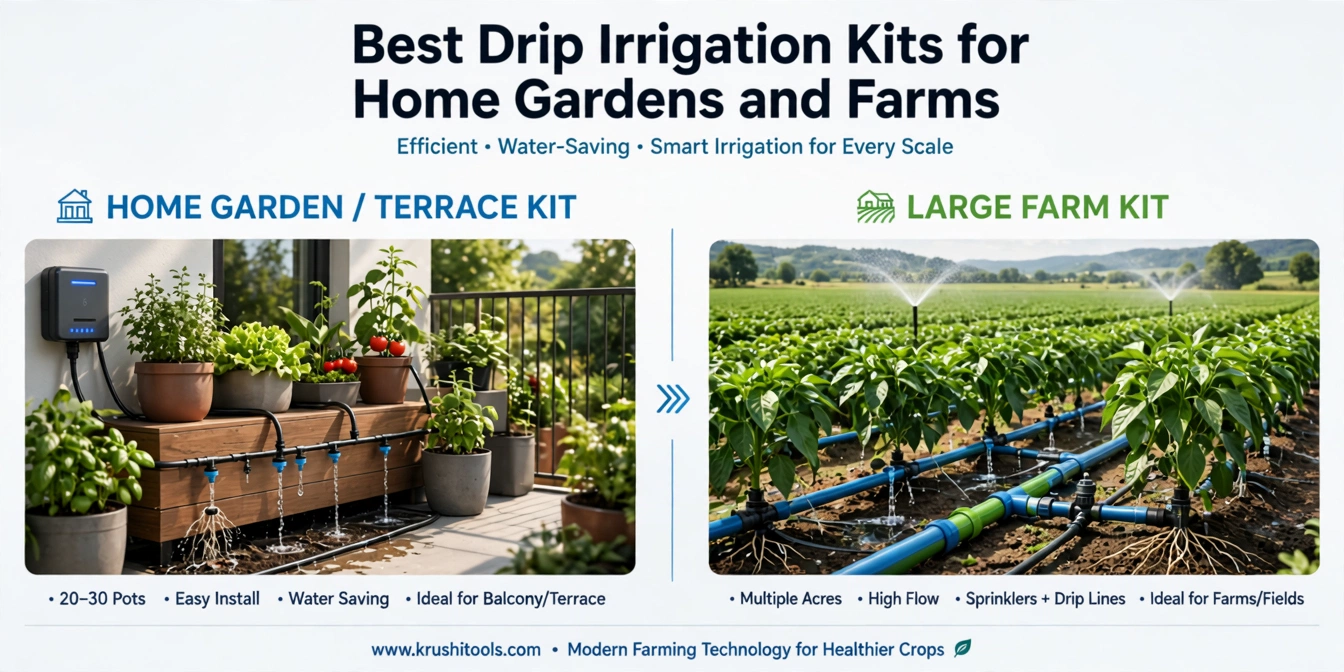
Best Drip Irrigation Kits for Home Gardens and Farms (2026 Guide)
Water is one of the most important resources for growing healthy plants and maintaining productive farms. However, traditional watering methods can sometimes waste water through runoff, evaporation and uneven distribution. This is where drip irrigation becomes a practical solution for modern gardening and agriculture.
Whether you maintain a small terrace garden, grow vegetables in your backyard, manage a greenhouse or cultivate crops across several acres, choosing the right drip irrigation kit can make watering easier and more controlled.
The best drip irrigation kits for home gardens and farms deliver water directly to plant root zones through pipes, drip lines and emitters. They help maintain consistent soil moisture, reduce unnecessary water application and make irrigation management more convenient.
In this guide, we will explore different types of drip irrigation kits, their components, benefits, prices and important factors to consider before buying a drip irrigation system in India.
What Is a Drip Irrigation Kit?
A drip irrigation kit is a collection of pipes, connectors, filters, valves and emitters designed to supply water slowly and directly to plants.
Unlike traditional flood irrigation or manual watering, a drip irrigation system distributes water through small outlets positioned near plant roots.
A basic drip irrigation kit generally includes:
-
- Main water supply pipe
-
- Drip irrigation lateral pipes
-
- Inline or adjustable drippers
-
- Water filter
-
- Pressure regulator
-
- Connectors and fittings
-
- End caps
-
- Control valves
-
- Optional irrigation timer
These components work together to deliver controlled water flow to different plants and crop rows.
Best Drip Irrigation Kits for Home Gardens and Farms
There is no single drip irrigation kit suitable for every garden or agricultural field. The ideal system depends on the garden size, crop type, water pressure, soil conditions and available water supply.
Here are the most useful types of drip irrigation systems to consider.
1. Drip Irrigation Kit for Home Gardens
A home garden drip irrigation kit is suitable for small gardens, balconies, terraces, flower beds and backyard vegetable gardens.
These kits generally include small-diameter tubing, adjustable drippers, connectors and a water supply adapter.
Best for:
-
- Balcony gardening
-
- Terrace gardens
-
- Home vegetable gardens
-
- Flower pots and planters
-
- Small kitchen gardens
Main advantages:
-
- Easy installation
-
- Suitable for beginners
-
- Controlled watering for individual plants
-
- Less manual watering
-
- Expandable with additional tubing
For a small garden, choose a kit with adjustable drippers so that you can control water delivery according to the needs of individual plants.
2. Drip Irrigation Kit for Vegetable Farming
Vegetable crops such as tomatoes, chilli, brinjal, cucumber, capsicum and cabbage can benefit from properly designed drip irrigation systems.
These systems commonly use inline drip pipes or drip tape with emitters positioned at suitable intervals.
Best for:
-
- Tomato cultivation
-
- Chilli farming
-
- Cucumber cultivation
-
- Capsicum farming
-
- Leafy vegetable production
Main advantages:
-
- Water delivered near the crop root zone
-
- More controlled irrigation
-
- Convenient watering across crop rows
-
- Compatible with fertigation equipment when properly designed
Choose emitter spacing according to crop spacing, soil type and the irrigation design.
3. Drip Irrigation Kit for Greenhouses and Polyhouses
Greenhouse and polyhouse cultivation requires careful water management because crops are often grown in organised rows, containers or growing beds.
A micro-irrigation system with individual drippers can provide controlled water delivery to plants.
Best for:
-
- Greenhouse vegetable cultivation
-
- Nursery plants
-
- Polyhouse farming
-
- High-value horticulture
-
- Container-based cultivation
Pressure-compensating emitters may be useful where uniform water delivery is important, especially when there are elevation differences.
4. Drip Irrigation Kit for Fruit Orchards
Fruit trees generally require different watering arrangements compared with small vegetable plants.
An orchard drip irrigation system uses mainlines, sub-main pipes, lateral pipes and individual emitters around trees.
Best for:
-
- Mango orchards
-
- Pomegranate farming
-
- Citrus cultivation
-
- Guava orchards
-
- Papaya cultivation
-
- Other fruit plantations
Adjustable or pressure-compensating drippers can be selected according to tree size, soil conditions and water requirements.
For mature trees, the number and placement of emitters may need to change as the root system expands.
5. Drip Irrigation System for Large Farms
Large agricultural fields require a properly planned irrigation network rather than a small ready-made garden kit.
A typical agricultural drip irrigation system includes a pump, filtration unit, mainline, sub-main, lateral pipes, valves and suitable emitters.
Best for:
-
- Commercial vegetable farms
-
- Large horticulture farms
-
- Sugarcane cultivation
-
- Fruit plantations
-
- Commercial agricultural projects
For larger farms, consult an irrigation specialist to calculate pump capacity, operating pressure, water requirements and suitable pipe dimensions.
Comparison of Different Drip Irrigation Kits
The following comparison will help you understand which type of system is suitable for your requirements.
| Drip irrigation type | Best application | Main feature |
|---|---|---|
| Home garden kit | Terrace and backyard gardens | Adjustable drippers |
| Vegetable drip kit | Vegetable farming | Inline drip lines |
| Greenhouse kit | Polyhouse cultivation | Individual plant watering |
| Orchard drip system | Fruit trees | Point-source emitters |
| Agricultural drip system | Large farms | Mainline and sub-main network |
Buying tip: Always check the actual kit contents, coverage, emitter flow rate, operating pressure and compatibility before purchasing. Coverage claims vary between manufacturers.
Important Components of a Drip Irrigation System
Before buying a drip irrigation kit, understand the main components and their functions.
1. Mainline Pipe
The mainline carries water from the source to the irrigation distribution network.
It is generally made from PVC, HDPE or suitable polyethylene material, depending on the system design.
2. Drip Lateral Pipe
Lateral pipes distribute water along individual plant rows.
They are commonly used in vegetable farms, orchards and garden beds.
3. Drippers or Emitters
Emitters control how much water reaches individual plants.
Common options include:
-
- Inline emitters
-
- Online drippers
-
- Adjustable drippers
-
- Pressure-compensating emitters
Choose the emitter according to crop type, spacing and required water flow.
4. Water Filter
Filtration is one of the most important parts of drip irrigation.
Dust, sand, organic matter and other particles can block small emitter openings.
Common filter types include:
-
- Screen filters
-
- Disc filters
-
- Media filters
The correct filter depends on water quality and system capacity.
5. Pressure Regulator
A pressure regulator maintains the operating pressure required by the drip irrigation components.
Excessive pressure can damage pipes, fittings and emitters, while insufficient pressure can result in uneven water distribution.
Always follow the pressure specifications provided by the irrigation equipment manufacturer.
6. Connectors and Fittings
Connectors join different sections of the irrigation network.
Common fittings include:
-
- Tee connectors
-
- Elbow connectors
-
- Joiners
-
- End caps
-
- Valves
-
- Pipe adapters
Good-quality fittings help reduce leakage and make maintenance easier.
7. Irrigation Timer
An automatic irrigation timer allows users to schedule watering.
It can be particularly useful for home gardens, nurseries and small farms where regular manual watering is inconvenient.
How to Choose the Best Drip Irrigation Kit
Selecting the right drip irrigation kit is important for efficient watering and long-term performance.
Consider these factors before making a purchase.
1. Garden or Farm Size
First, calculate the total area that needs irrigation.
A small terrace garden may require a simple micro-irrigation kit, while a commercial farm may need a professionally designed system.
2. Type of Plants and Crops
Different plants have different water requirements.
For example:
-
- Flower pots may need individual adjustable drippers.
-
- Vegetable rows may require inline drip tubing.
-
- Fruit trees may need multiple emitters around the root zone.
Choose the irrigation arrangement according to the crop.
3. Water Source
Check whether your water comes from a borewell, open well, storage tank, pond or municipal supply.
Water quality affects filter selection and maintenance requirements.
4. Water Pressure
Check the available water pressure before buying a kit.
Some systems require a pump, while others can operate using an appropriate gravity-fed supply.
Never assume that every drip kit works with every water source.
5. Pipe Quality
Look for durable, UV-resistant materials suitable for outdoor agricultural use.
Check pipe diameter, wall thickness, pressure rating and manufacturer specifications.
6. Filter and Maintenance Requirements
A good filtration system helps reduce emitter blockage.
Choose a kit that provides convenient access to filters, flushing points and replaceable components.
7. Expandability
If you plan to increase your garden or farming area later, choose a system that can accommodate additional drip lines and watering zones.
Drip Irrigation Kit Price in India
The price of a drip irrigation kit depends on its size, material quality, number of components, brand and installation requirements.
Small home garden kits generally cost less than agricultural drip irrigation systems.
The following table provides a practical buying classification rather than fixed market prices.
| Kit category | Typical use | Main cost factors |
|---|---|---|
| Basic garden kit | Small gardens and pots | Tubing and drippers |
| Adjustable dripper kit | Mixed plants and planters | Number of outlets |
| Vegetable drip kit | Vegetable beds | Drip tape and fittings |
| Greenhouse kit | Protected cultivation | Drippers and control equipment |
| Farm irrigation system | Commercial farming | Pipes, filters, pumps and installation |
Before purchasing, compare the complete kit contents instead of choosing only by the lowest advertised price.
For large farms, installation and equipment costs should be estimated using an actual field layout and water-flow calculation.
Benefits of Using Drip Irrigation Kits
Drip irrigation offers several advantages for home gardeners and agricultural producers.
1. More Controlled Water Application
Water is delivered close to plant roots, helping users manage irrigation more precisely.
2. Reduced Water Wastage
A properly designed drip system can reduce unnecessary water application caused by runoff and evaporation compared with some conventional irrigation methods.
Actual savings depend on the crop, soil, climate and irrigation management.
3. Better Irrigation Management
Gardeners and farmers can divide their irrigation network into different zones and manage watering according to plant requirements.
4. Reduced Manual Work
Drip irrigation reduces the need to water every plant manually.
Automatic timers can make the process more convenient.
5. Suitable for Different Crops
Drip systems can be designed for vegetables, flowers, fruit trees, nurseries and many other agricultural applications.
6. Fertigation Compatibility
Some drip irrigation systems support fertigation, which involves applying suitable water-soluble fertilisers through irrigation water.
However, fertigation requires compatible equipment, correct fertiliser selection and proper system flushing.
How to Install a Drip Irrigation Kit
Installing a small drip irrigation kit can be relatively simple if you follow the manufacturer’s instructions.
Here is a general installation process.
Step 1: Prepare the Layout
Measure the garden or farming area and identify the location of each plant row.
Step 2: Connect the Water Source
Connect the main water supply to the irrigation system using compatible fittings.
Step 3: Install the Filter
Install the correct filter to prevent dirt and debris from entering the drip lines.
Step 4: Install the Pressure Regulator
Fit the regulator according to the system’s recommended operating pressure.
Step 5: Connect the Mainline
Lay the main pipe along the required watering area.
Step 6: Attach Drip Lines
Connect the lateral pipes or drip tape to the mainline using suitable connectors.
Step 7: Install Emitters
Position emitters according to plant spacing and irrigation requirements.
Step 8: Flush and Test the System
Flush the pipes before closing the ends. Run the system and check for leakage, blocked emitters and uneven water distribution.
For large agricultural installations, professional system design and installation are recommended.
Common Drip Irrigation Problems and Their Solutions
Even a good-quality drip irrigation kit requires regular maintenance.
Here are some common problems.
| Problem | Possible reason | Solution |
|---|---|---|
| Drippers are blocked | Dirt or mineral deposits | Clean filters and flush lines |
| Uneven water flow | Incorrect pressure | Check pressure and system design |
| Pipe leakage | Damaged fittings | Replace damaged connectors |
| Low water delivery | Insufficient supply | Check pump and water source |
| Water not reaching the last plants | Excessive lateral length or flow demand | Review pipe sizing and zoning |
Regular inspection can help maintain consistent system performance.
Is Drip Irrigation Suitable for Small Farmers in India?
Yes. Drip irrigation can be useful for small and marginal farmers when the system is designed according to their available water supply, crop type and land conditions.
Farmers growing vegetables, fruits and horticultural crops can consider micro-irrigation as an alternative to conventional watering methods.
In India, eligible farmers may also be able to access government assistance under applicable micro-irrigation programmes.
For example, the Per Drop More Crop component has supported the adoption of micro-irrigation in agriculture.
However, subsidy availability, eligibility, assistance rates and application procedures can vary by state and current government guidelines.
Farmers should check the latest information through their state agriculture department or the official government portal before purchasing equipment.
Best Drip Irrigation Kit: Which One Should You Buy?
Your ideal kit depends on the application.
-
- For balcony gardens: Choose a compact kit with adjustable drippers.
-
- For terrace gardens: Choose a kit with sufficient tubing, connectors and a filter.
-
- For vegetable farming: Consider inline drip pipes or drip tape with suitable emitter spacing.
-
- For greenhouses: Choose a system with individual plant emitters and pressure control.
-
- For fruit orchards: Consider durable lateral pipes and suitable online drippers.
-
- For large farms: Choose a professionally designed agricultural drip irrigation system with appropriate filtration and zone controls.
Remember, the best drip irrigation kit is not necessarily the most expensive one. It is the system that matches your water supply, crop requirements, field layout and maintenance capacity.
Frequently Asked Questions (FAQs)
1. Which drip irrigation kit is best for a home garden?
A compact drip irrigation kit with adjustable drippers, flexible tubing, connectors and a suitable filter is a good choice for most small home gardens.
2. Which drip irrigation system is best for agriculture?
Inline drip irrigation pipes are commonly suitable for vegetable farming, while online drippers and durable lateral pipes can be useful for orchards. Large farms require a system designed according to water flow and crop requirements.
3. Can drip irrigation work without electricity?
Yes. Some drip irrigation systems can operate using gravity-fed water from an elevated tank, provided sufficient pressure and flow are available. Larger systems may require a pump.
4. How much water can drip irrigation save?
Drip irrigation can significantly reduce unnecessary water application compared with poorly managed conventional irrigation. However, the actual savings depend on crop type, soil, climate, irrigation scheduling and system design.
5. Is a filter necessary for drip irrigation?
Yes. Filtration is important because small particles can block emitters. The filter type should match the water quality and manufacturer’s recommendations.
6. What is the difference between drip tape and drip pipe?
Drip tape is generally a thin-walled irrigation product used for seasonal crops and vegetable rows. Drip pipe or tubing is available in different thicknesses and configurations and is commonly used in gardens, orchards and longer-term installations.
7. Can drip irrigation be used for fruit trees?
Yes. Drip irrigation can be used for mango, pomegranate, citrus, guava and other fruit trees. The number, flow rate and placement of emitters should match tree size and soil conditions.
8. Is drip irrigation eligible for government subsidy in India?
Eligible farmers may receive assistance through applicable micro-irrigation programmes, depending on current central and state government guidelines. Check the official agriculture department for the latest eligibility and application information.
9. How often should drip irrigation pipes be cleaned?
Filters should be inspected and cleaned regularly. Drip lines should also be flushed according to water quality, manufacturer instructions and observed sediment buildup.
10. What should I check before buying a drip irrigation kit?
Check the pipe material, filter, pressure requirements, emitter flow rate, pipe length, fittings, coverage claims, warranty and availability of replacement components.
Conclusion
Choosing the best drip irrigation kits for home gardens and farms can make watering more convenient and improve irrigation management.
Whether you are maintaining a few balcony plants or managing a commercial agricultural field, the right drip irrigation system should match your plant requirements, water source, pressure and available budget.
Always compare the quality of pipes, emitters, filters and fittings before purchasing. Proper installation and regular maintenance are equally important for long-term performance.
At Krushi Tools, we aim to provide practical information about agricultural equipment, modern farming methods, irrigation systems and useful resources for Indian farmers.
Explore more farming guides on Krushi Tools to make informed decisions about agricultural tools and irrigation equipment.