
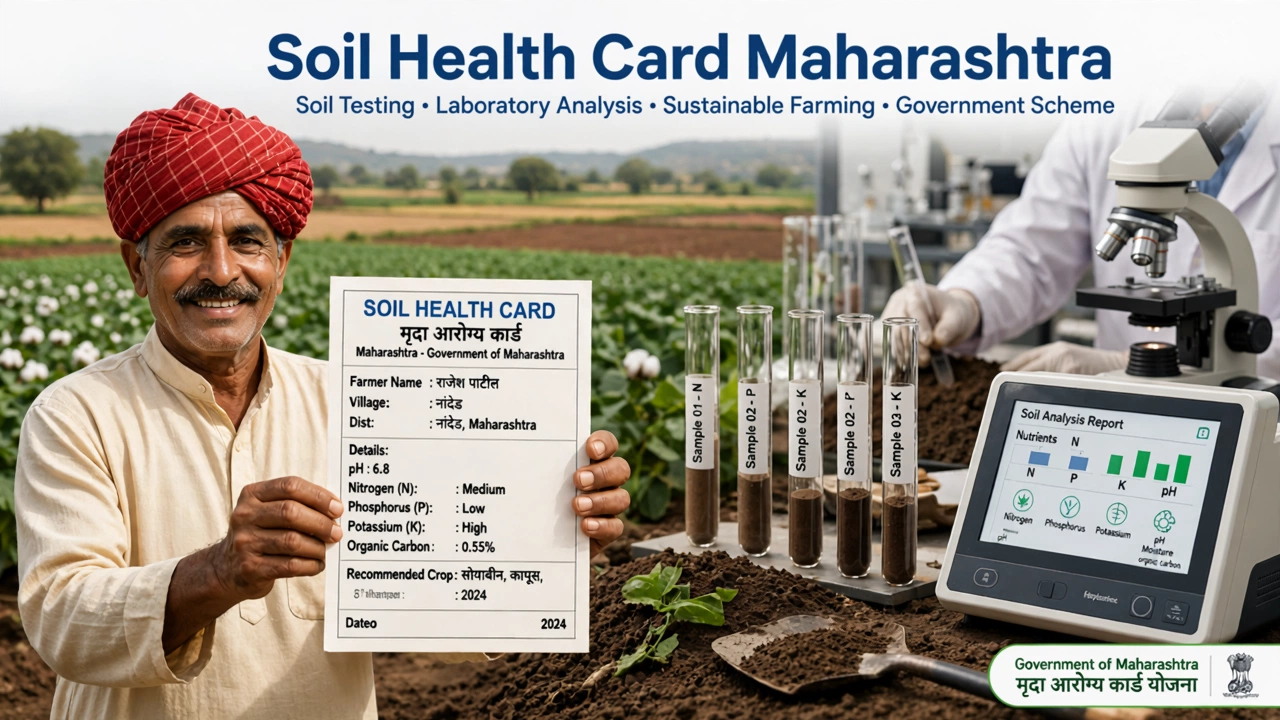
Soil Health Card Maharashtra 2026: Online Apply, Soil Testing, Benefits & Download
Healthy soil is the foundation of successful farming. For farmers in Maharashtra, understanding soil quality is essential for selecting suitable crops, applying the correct fertilisers, and improving agricultural productivity.
The Soil Health Card Maharashtra initiative helps farmers understand the nutrient status of their agricultural land through scientific soil testing. The report provides information about soil nutrients, soil acidity or alkalinity, organic carbon, and recommendations for fertiliser application.
Whether you grow cotton, soybean, sugarcane, paddy, wheat, or vegetables, soil testing can help you make better farming decisions.
In this guide, you will learn how to apply for a Soil Health Card in Maharashtra, where to get your soil tested, which documents may be required, how to download your card, and how to use the report to improve soil fertility.
What Is a Soil Health Card?
A Soil Health Card (SHC) is a report that describes the condition of agricultural soil based on laboratory testing.
The Government of India’s Soil Health Card programme provides farmers with information about soil nutrients and recommendations for managing fertilisers and soil amendments. The national portal supports generating cards in multiple Indian languages. https://soilhealth.dac.gov.in/
The report helps farmers understand:
- Which nutrients are available in their soil.
- Whether the soil is acidic, neutral, or alkaline.
- The status of organic carbon.
- Which nutrients may need improvement.
- How to manage fertilisers according to soil test recommendations.
- Which soil amendments may be appropriate for the tested field.
The main objective is to promote soil-test-based fertiliser use, improve soil fertility, and help farmers manage cultivation costs.
Soil Health Card Maharashtra: Key Details
| Particular | Information |
|---|---|
| Scheme name | Soil Health Card Scheme |
| State | Maharashtra |
| Implementing authorities | Agriculture departments and designated soil-testing agencies |
| Beneficiaries | Farmers across India, including Maharashtra |
| Main purpose | Soil testing and nutrient management |
| Testing parameters | 12 key soil parameters |
| Application guidance | District or Block Agriculture Office |
| Official portal | soilhealth.dac.gov.in |
The Soil Health Card component is now part of the Rashtriya Krishi Vikas Yojana (RKVY) under Soil Health and Fertility. Eligibility for testing is broad, but the sampling arrangements and charges for particular services may vary. https://www.myscheme.gov.in/schemes/rkvyshfshc
Benefits of the Soil Health Card for Farmers
1. Understand Your Soil Quality
Soil testing provides information about nutrient availability and important soil properties. This helps farmers make decisions based on measured soil conditions rather than guesswork.
2. Apply Fertilisers More Efficiently
The report provides nutrient and fertiliser recommendations. Following appropriate recommendations can help avoid unnecessary or excessive fertiliser application.
3. Improve Crop Management
Soil test results can help farmers plan nutrient management for crops such as cotton, soybean, sugarcane, paddy, wheat, and vegetables.
Crop selection should also consider rainfall, irrigation, climate, soil texture, and local agricultural recommendations.
4. Manage Soil Fertility
Regular soil testing can help farmers identify nutrient deficiencies and make appropriate improvements over time.
5. Support Sustainable Agriculture
Balanced nutrient management and suitable organic inputs can support long-term soil productivity.
6. Make Better Farming Decisions
A soil test report provides useful information for planning fertiliser purchases, soil amendments, and crop nutrient management.
What Are the 12 Parameters Tested in a Soil Health Card?
The standard Soil Health Card reports 12 key parameters. These include macro-nutrients, secondary or micro-nutrients as classified in the programme, and physical or chemical indicators of soil condition. https://soilhealth.dac.gov.in/files/FAQ_Final_English.pdf
| Parameter | What it indicates |
|---|---|
| Nitrogen (N) | Nutrient associated with vegetative growth |
| Phosphorus (P) | Nutrient important for root development and energy transfer |
| Potassium (K) | Nutrient involved in plant water regulation and other functions |
| Sulphur (S) | Essential nutrient for plant growth |
| Zinc (Zn) | Micronutrient required for plant development |
| Iron (Fe) | Micronutrient involved in chlorophyll formation |
| Copper (Cu) | Micronutrient required in small quantities |
| Manganese (Mn) | Micronutrient involved in plant processes |
| Boron (B) | Micronutrient important for reproductive growth |
| pH | Indicates soil acidity or alkalinity |
| Electrical Conductivity (EC) | Indicates the concentration of soluble salts |
| Organic Carbon (OC) | Indicates the level of organic carbon in soil |
The results should be interpreted using the laboratory’s reference ranges and recommendations for the relevant crop and soil conditions.
How to Apply for a Soil Health Card in Maharashtra
Farmers can begin the process by contacting the agriculture department responsible for their area.
Step 1: Contact Your Agriculture Office
Visit or contact your District Agriculture Officer or Block Agriculture Officer. Ask about the current soil-testing programme, sample collection arrangements, and the process for generating a Soil Health Card.
Step 2: Provide Your Farmer and Land Details
Be prepared to provide the details requested by the department, such as:
- Farmer’s name and contact details.
- Village, taluka, and district.
- Agricultural land details.
- Survey or Gat number, where required.
- Farmer ID or other identification details, if applicable.
The exact requirements may vary according to the state’s current process.
Step 3: Arrange Soil Sample Collection
The department or authorised sampling personnel can explain how the soil sample will be collected.
Proper sampling matters because an unrepresentative sample can lead to misleading test results.
Step 4: Laboratory Testing
The soil sample is sent to a designated soil-testing laboratory. The laboratory analyses the required parameters and records the results.
Step 5: Soil Health Report Generation
After the results are processed, a Soil Health Card can be generated through the designated system. The report includes nutrient information and relevant recommendations.
Step 6: Obtain Your Soil Health Card
Ask the concerned office how to receive your card or access the digital report. If the report is available online, use the official portal and follow its instructions.
Official portal: https://soilhealth.dac.gov.in/
The process may depend on whether your village is covered under the current sampling programme and whether your soil sample has already been registered.
Documents Required for Soil Health Card Maharashtra
Documents and details may vary by service and district.
Farmers should be prepared to provide the following when requested:
- Farmer identification details.
- Mobile number and contact information.
- Agricultural land details.
- Survey or Gat number, where applicable.
- Farmer ID, if required by the current system.
- Soil sample and sample slip, where applicable.
The Wardha district administration lists a soil sample and sample slip among the requirements for its soil health card service. Confirm the current requirements with your local office before visiting. https://wardha.gov.in/en/soil-health-card-mission/
How to Download a Soil Health Card Online
If your soil sample has been tested and your report is available in the national system, follow these steps:
- Visit the official Soil Health Card portal: https://soilhealth.dac.gov.in/
- Look for the farmer-facing card, report, or download facility.
- Follow the portal’s instructions to identify your report.
- Enter the requested information, such as state, district, or other details.
- If prompted, provide the relevant farmer, sample, or registration information.
- Open the available soil health report and download or print it.
The exact menus and information required may change as the portal is updated.
Important: If your card does not appear online, contact the soil-testing laboratory or agriculture office that handled your sample. The report may not yet have been generated or linked to the details you entered.
Soil Health Card Application Fees in Maharashtra
The cost of soil testing depends on the type of sample, the service, and the applicable government arrangements.
For example, the Wardha district administration lists fees ranging from ₹35 to ₹275 depending on the type of sample. These figures should not be treated as a statewide fixed rate. https://wardha.gov.in/en/soil-health-card-mission/
Before submitting a sample, ask your local agriculture office or designated laboratory:
- Whether your sample is covered under a government-supported programme.
- Whether any testing or service fee applies.
- Which parameters are included in the test.
- How and when you will receive the report.
How to Collect a Good Soil Sample
Correct sampling is important for obtaining meaningful laboratory results.
General precautions include:
- Select representative areas of the field.
- Avoid unusual spots such as manure heaps, field edges, waterlogged patches, and areas directly affected by fertiliser piles.
- Use the sampling depth specified by the relevant agriculture department.
- Collect soil from representative locations according to the sampling instructions.
- Mix the collected soil properly if instructed to do so.
- Label the sample correctly and provide the required field details.
Government guidance describes collecting samples from a depth of approximately 15–20 cm using a V-shaped cut, with representative sampling locations across the field. Follow the sampling instructions issued for your specific land and testing programme. https://soilhealth.dac.gov.in/files/FAQ_Final_English.pdf
How to Use Soil Health Card Results for Different Crops
A Soil Health Card is most useful when its results are interpreted alongside the crop you intend to grow.
| Crop | How soil testing can help |
|---|---|
| Cotton | Plan nutrient management and identify potential deficiencies |
| Soybean | Assess soil fertility and support balanced nutrient management |
| Sugarcane | Plan nutrient application for a long-duration crop |
| Paddy | Evaluate soil properties and nutrient requirements |
| Wheat | Support fertiliser planning based on tested soil conditions |
| Vegetables | Identify nutrient management needs for the selected crop |
Always follow the crop-specific recommendations in your report and seek guidance from an agricultural officer or Krishi Vigyan Kendra (KVK) when results require interpretation.
Do not apply additional fertiliser solely because a nutrient appears low without considering the report’s recommended dose, crop stage, existing fertiliser applications, and local agronomic guidance.
Frequently Asked Questions (FAQs)
1. How can I apply for a Soil Health Card in Maharashtra?
Contact your District Agriculture Officer or Block Agriculture Officer to request soil testing and card generation. The department can explain whether your village is covered under the current programme and what information is required.
2. What is the official Soil Health Card website?
The official national portal is https://soilhealth.dac.gov.in/. Farmers can use the available services and instructions to access soil health information and reports.
3. Is the Soil Health Card available for all farmers?
The national scheme is intended for farmers across India. However, the timing of sampling, availability of particular services, and applicable charges should be confirmed with the relevant agriculture department.
4. How many parameters are included in a Soil Health Card?
The standard card covers 12 parameters, including N, P, K, S, Zn, Fe, Cu, Mn, B, pH, EC, and organic carbon.
5. Is soil testing free in Maharashtra?
The cost depends on the applicable programme and type of test. Confirm whether your sample is covered by a government-supported service or whether a fee applies.
6. How often should soil be tested?
The Soil Health Card programme has traditionally followed a three-year cycle for issuing cards. Additional testing may be useful when advised by an agricultural expert or when a particular soil or crop problem needs investigation.
7. What should I do if my Soil Health Card is not available online?
Contact the laboratory or agriculture office handling your sample. Ask whether the sample has been tested, whether the results have been uploaded, and how you can obtain the report.
8. Does a Soil Health Card guarantee higher crop production?
No. It provides useful soil information and recommendations, but crop yield also depends on rainfall, irrigation, seed quality, pest management, weather, and other farming practices.
Conclusion
The Soil Health Card Maharashtra programme helps farmers understand the condition of their agricultural land and make informed decisions about fertiliser use and soil fertility management.
By testing soil before making major nutrient-management decisions, farmers can identify potential deficiencies, use fertilisers more appropriately, and plan crop management according to their field conditions.
If you want to obtain a Soil Health Card, contact your local agriculture office, follow the current soil-sampling procedure, and use the official portal to access your report when it becomes available.
Visit KrushiTools.com for more agricultural information, farming guides, government scheme updates, and practical resources for farmers.
Disclaimer: This article is for general information. Application procedures, fees, document requirements, and service availability may change. Confirm the latest details with the Maharashtra Agriculture Department or the relevant soil-testing laboratory.