What Is a Drone Sprayer? Complete Beginner’s Guide
Agricultural technology is advancing faster than ever, and if you have spent any time around modern farms or agri-equipment discussions recently, you have likely heard about drone sprayers. What Is a Drone Sprayer? Complete Beginner’s Guide.
Gone are the days when spraying pesticides or liquid fertilizers meant walking miles with a heavy tank strapped to your back or driving heavy tractors that compact soil and crush crops. Drone sprayers—also known as agricultural spray drones or UAV (Unmanned Aerial Vehicle) sprayers—are rapidly becoming essential equipment for progressive farmers, custom hiring centers, and agri-entrepreneurs.
Whether you are curious about how this tech works, exploring ways to lower input costs, or looking to buy your first unit, this beginner’s guide covers everything you need to know.
What Is an Agricultural Drone Sprayer?
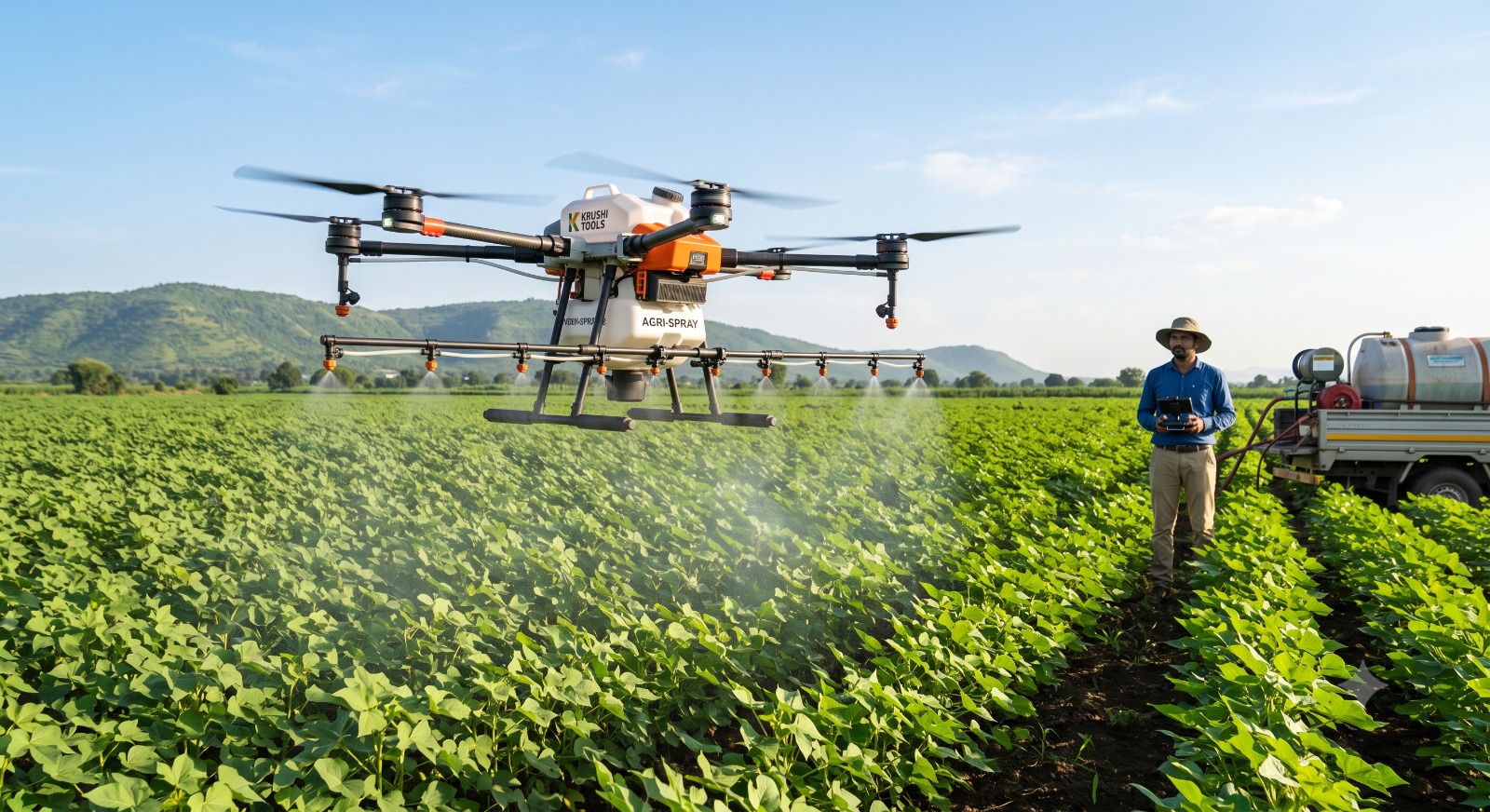
An agricultural drone sprayer is an unmanned aerial vehicle specifically engineered to carry and distribute liquid or granular materials over farmland. Instead of relying on manual labor or ground machinery, these heavy-duty multi-rotor drones fly autonomously or semi-autonomously over crop canopies to apply:
Liquid Pesticides & Insecticides: For targeted pest control.
Fungicides & Herbicides: For crop protection and weed management.
Liquid Fertilizers (e.g., Nano Urea): For direct foliar feeding.
Granular Materials: Seeds, micro-nutrients, or solid fertilizers (using specialized spreader attachments).
Equipped with high-capacity tanks, electric pumps, precision spray nozzles, and advanced GPS/radar sensors, a single spray drone can treat 20 to 50+ acres in a single day with pinpoint accuracy.
How Does a Drone Sprayer Work?
At a glance, a spray drone looks like a large commercial drone with a container underneath. But behind its flight operation is a tightly integrated mechanical and electronic spraying system:
[ Tank & Chemical Mixture ] ➔ [ Diaphragm/Centrifugal Pump ] ➔ [ Flow Controller & Radar ] ➔ [ Spray Nozzles under Rotors ]
Mission Planning: The operator maps the field boundaries using a handheld smart controller or mobile application. The flight route, flying height (usually 1.5 to 3 meters above crop level), and flight speed are set digitally.
Pressurized Spray System: An onboard electric pump draws liquid from the central payload tank and pushes it through specialized pressure or rotary atomizer nozzles.
The Rotor Downdraft Effect: As the drone hovers, the powerful downwash generated by its heavy-duty propellers pushes the mist deep into the crop canopy. This coats both the upper and lower sides of the leaves, providing far better coverage than standard top-down manual spraying.
Terrain Following & Obstacle Avoidance: Millimeter-wave radars and vision sensors allow the drone to maintain a constant distance from crops even on hillsides or undulating terrain while automatically dodging trees and power poles.
Key Components of a Spray Drone
To understand what you are buying or operating, it helps to break down the drone into five main systems:
1. Frame and Propulsion
Built using lightweight carbon fiber and aviation-grade aluminum alloys. Most spraying drones are quadcopters (4 rotors), hexacopters (6 rotors), or octocopters (8 rotors) designed to support heavy payloads while resisting dust and water (typically rated IP67 for easy washdowns). What Is a Drone Sprayer? Complete Beginner’s Guide.
2. Spray Tank
Tank capacities generally range from 10 Liters to 40+ Liters for standard agricultural models (and up to 70–100L for commercial-grade giant drones). Most tanks are made of high-density polyethylene (HDPE) to withstand corrosive agricultural chemicals.
3. Pump & Nozzles
Flat Fan Nozzles: Produce fan-shaped spray patterns and work well for broad crop coverage.
Rotary Atomizer Discs: Spin at high speeds to break liquid into controllable droplet sizes (e.g., 50–300 microns), reducing chemical drift.
4. Smart Flight Controller & GPS
Integrates RTK (Real-Time Kinematic) GPS systems for centimeter-level flight positioning. This ensures the drone doesn’t miss a spot or overspray the same row twice.
5. High-Discharge Smart Batteries & Fast Chargers
Drones run on high-capacity Lithium-Polymer (LiPo) or Lithium-Ion smart batteries. Flight times under full load usually average 10 to 18 minutes per battery, while high-output industrial chargers can recharge a battery in 9 to 12 minutes.
Comparison: Manual vs. Tractor vs. Drone Spraying
| Feature | Manual Knapsack Sprayer | Tractor Boom Sprayer | Drone Sprayer |
| Speed / Daily Coverage | 1 – 2 acres/day | 15 – 25 acres/day | 30 – 80+ acres/day |
| Water Usage | High (150–200 L/acre) | High (100–150 L/acre) | Ultra-Low (8–12 L/acre) |
| Pesticide Savings | Baseline | Moderate | 20% – 40% Savings |
| Crop/Soil Damage | Soil compaction, trampled crops | High crop trampling & soil compaction | Zero ground impact |
| Operator Hazard | High (direct chemical exposure) | Moderate (cab exposure) | Zero direct contact |
| Terrain Flexibility | Flexible but slow | Flat terrain only | Works on hillsides, wet soil, & tall crops |
Major Advantages of Using a Drone Sprayer
1. Massive Savings on Water and Chemicals
Conventional spraying relies on flooding crops with high volumes of water. Drones use Ultra-Low Volume (ULV) technology. Fine, uniform droplets combined with propeller downwash mean you get maximum foliage absorption using up to 90% less water and 20–40% less active pesticide.
2. Eliminates Health Risks for Operators
Manual spraying exposes laborers to toxic chemical fumes, skin contact, and long-term health hazards. Drones allow operators to stand safely at the field boundary, controlling operations remotely. What Is a Drone Sprayer? Complete Beginner’s Guide.
3. Operates in Wet, Muddy, or Tall Field Conditions
After heavy rainfall, tractors and manual workers cannot enter flooded fields without sinking or damaging crops. Spray drones fly over mud, tall sugarcane, cotton, fruit orchards, and dense crop canopies without touching the ground.
What to Consider Before Buying Your First Drone Sprayer
If you are planning to purchase a drone for your farm or custom spraying service, keep these essential factors in mind:
Tank Size: A 10L to 16L drone is great for small to mid-sized individual farms. For commercial custom hiring or large acreages, 30L to 40L+ models offer higher daily output.
Battery Setup: Always budget for at least 3 to 4 battery sets and a fast generator/charging station so you can cycle batteries continuously without stopping field operations.
Regulations & Certification: Most countries require agricultural drones to be registered (e.g., getting a Unique Identification Number or FAA registration) and operated by a certified remote pilot. What Is a Drone Sprayer? Complete Beginner’s Guide.
Maintenance & Spare Parts: Ensure that replacement propellers, arms, pumps, and nozzles are readily available from your dealer.
Final Summary
A drone sprayer is no longer a futuristic luxury—it is a practical, high-efficiency farm tool that solves labor shortages, slashes input costs, and protects farmer health. As government subsidies and custom hiring centers make drone technology more affordable, smart spraying is quickly becoming the new industry standard for modern agriculture.
Looking for top-rated spraying equipment, battery tools, and agricultural machinery guides? Explore more tutorials and product breakdowns right here on Krushitools.com!