
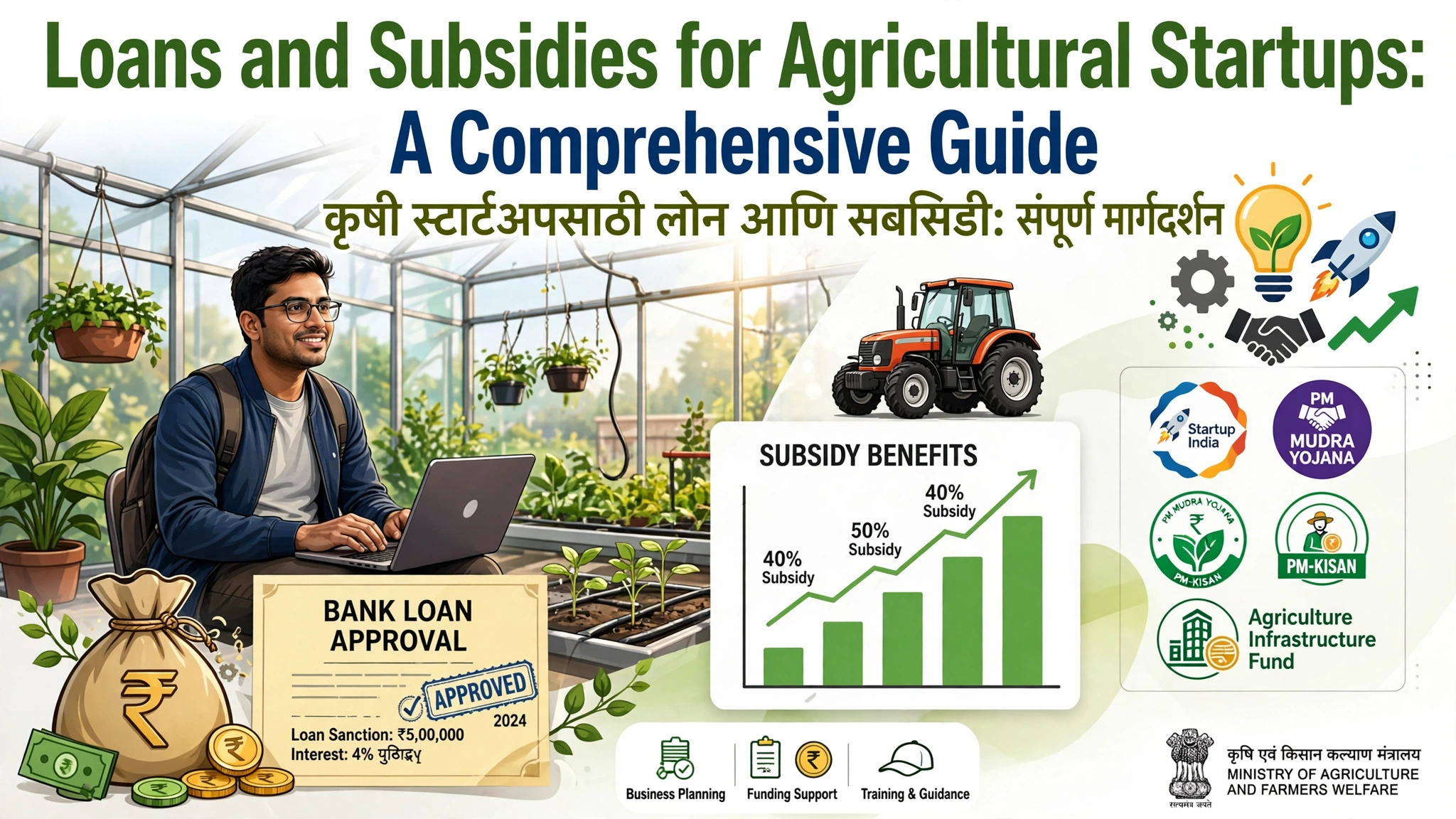
Loans and Subsidies for Agricultural Startups: A Comprehensive Guide
कृषी स्टार्टअपसाठी लोन आणि सबसिडी: संपूर्ण मार्गदर्शन
Starting an agriculture-related business in India can require significant investment in machinery, storage, food processing, irrigation, technology, transportation and working capital. Government-backed financing schemes and startup programs can help eligible entrepreneurs reduce financing costs or access support.
This guide explains agricultural startup loans, subsidies, government schemes, eligibility, application process, documents and practical tips for starting or expanding an agri-business in India.
Important: Scheme rules, eligibility, application windows and subsidy limits can change. Always verify the current conditions on the official government portal before applying.
Table of Contents
- What Is an Agricultural Startup?
- Why Agricultural Startups Need Financing
- Loan vs Subsidy – What Is the Difference?
- Major Government Schemes for Agricultural Startups
- Agriculture Infrastructure Fund (AIF)
- Startup India Seed Fund Scheme
- Credit Guarantee Scheme for Startups
- PMFME Scheme for Food Processing
- Other Financing Options
- Who Can Apply?
- Documents Required
- How to Apply for an Agriculture Business Loan
- Example of a Small Agricultural Startup
- How to Prepare a Project Report
- Common Mistakes to Avoid
- FAQs
- Conclusion
1. What Is an Agricultural Startup?
An agricultural startup is a business that develops products or services connected with agriculture, farming, food processing, agricultural technology or the agricultural supply chain.
Examples include:
- Farm machinery rental businesses
- Agricultural equipment dealerships
- Drip irrigation businesses
- Solar agricultural solutions
- Food processing units
- Cold storage businesses
- Grain cleaning and grading units
- Seed and agricultural-input businesses
- Farm-management technology
- Agri e-commerce platforms
- Drone-based agricultural services
- Organic farming businesses
- Dairy and livestock businesses
- Post-harvest management businesses
- Agricultural transportation and logistics
- Digital agriculture platforms
For entrepreneurs interested in agricultural machinery, businesses involving equipment such as power tillers, sprayers, chaff cutters, threshers, mini harvesters and other farm machines can also form part of an agriculture-focused business model.
2. Why Do Agricultural Startups Need Financing?
Agriculture businesses can require capital at different stages.
For example, an entrepreneur starting a farm machinery rental business may need money for:
- Purchasing agricultural machines
- Setting up a workshop
- Buying spare parts
- Transportation
- Website and software development
- Marketing
- Employee salaries
- Insurance
- Working capital
A food-processing startup may additionally require:
- Processing machinery
- Packaging equipment
- Storage facilities
- Quality-control equipment
- Licenses and registrations
- Branding and marketing
- Raw materials
Government schemes can sometimes provide interest support, credit-linked subsidy, guarantees or startup funding, depending on the nature and eligibility of the project.
3. Loan vs Subsidy – What Is the Difference?
Understanding the difference between a loan and subsidy is important before applying.
Agricultural Business Loan
A loan is borrowed money that generally has to be repaid with interest according to the lender’s terms.
The lender may consider:
- Business plan
- Project cost
- Promoter contribution
- Credit history
- Cash-flow projections
- Collateral/security requirements
- Business viability
Government Subsidy
A subsidy is financial support provided under a government scheme subject to its rules.
A subsidy does not necessarily mean that the government simply gives cash directly to the entrepreneur.
In many credit-linked schemes, the subsidy is connected with a bank loan and may be adjusted according to the scheme’s conditions.
For example, the Ministry of Food Processing Industries states that PMFME provides a 35% credit-linked capital subsidy up to ₹10 lakh per eligible individual micro food-processing unit, with minimum beneficiary contribution requirements. (Ministry of Food Processing Industries)
Therefore, entrepreneurs should always read the current scheme guidelines rather than assuming that a subsidy is an upfront cash payment.
4. Major Government Schemes for Agricultural Startups
Several government programs can be relevant to agriculture and agri-food businesses.
Some important programs to research include:
| Scheme | Potential Use |
|---|---|
| Agriculture Infrastructure Fund (AIF) | Post-harvest and agricultural infrastructure |
| Startup India Seed Fund Scheme | Proof of concept, prototype and commercialization |
| Credit Guarantee Scheme for Startups | Credit support for eligible DPIIT-recognized startups |
| PMFME | Micro food-processing businesses |
| MUDRA | Micro-enterprise financing through eligible lenders |
| CGTMSE | Credit guarantee support for eligible MSE lending |
| State Government Schemes | Agriculture-specific support depending on state |
Eligibility and benefits differ significantly between schemes.
5. Agriculture Infrastructure Fund (AIF)
The Agriculture Infrastructure Fund is particularly relevant to businesses involved in agricultural infrastructure and post-harvest management.
According to the Government of India’s Startup Schemes Playbook, AIF provides an interest subvention of 3% per annum on eligible loans up to ₹2 crore for a maximum period of 7 years, subject to the applicable scheme conditions. Eligible categories include agri-entrepreneurs and startups among other beneficiaries. (Startup India)
What types of businesses can potentially benefit?
Depending on the applicable guidelines, projects can involve areas such as:
- Warehouses
- Cold storage
- Post-harvest infrastructure
- Primary processing
- Agricultural logistics
- Community farming assets
- Other eligible agricultural infrastructure
Why is AIF important?
Suppose an eligible project requires substantial investment in post-harvest infrastructure. An interest subvention can reduce the effective interest burden during the eligible period.
However, the entrepreneur still needs to satisfy the lender’s requirements and the scheme’s eligibility conditions.
6. Startup India Seed Fund Scheme
The Startup India Seed Fund Scheme (SISFS) is designed for eligible startups at an early stage.
The official scheme information states that eligible startups can receive:
- Up to ₹20 lakh as a grant for validation, proof of concept, prototype development or product trials.
- Up to ₹50 lakh for market entry, commercialization or scaling through specified debt/convertible instruments.
The scheme is sector-agnostic but gives preference to areas including agriculture, food processing, biotechnology and other sectors listed by the program. (Seed Fund)
Who can benefit?
The scheme is intended for eligible DPIIT-recognized startups meeting the applicable requirements.
This can be particularly relevant to technology-oriented agricultural startups developing:
- Smart farming technology
- IoT agricultural devices
- Farm-management software
- Agricultural marketplaces
- AI-based agricultural solutions
- Innovative farm machinery
- Food-processing technology
7. Credit Guarantee Scheme for Startups
The Credit Guarantee Scheme for Startups (CGSS) is designed to provide credit guarantee support for eligible DPIIT-recognized startups.
According to Startup India, the revised framework increased the maximum debt eligible for guarantee cover to ₹20 crore per borrower, subject to scheme conditions. The guarantee is provided through the designated mechanism to eligible lending institutions rather than being paid directly to the startup. (Startup India)
This type of support can be useful because access to debt can be challenging for young businesses without a long operating history.
However, a credit guarantee does not automatically mean loan approval. The lending institution still evaluates the startup and project.
8. PMFME Scheme for Food Processing
If your agricultural startup involves food processing, PMFME is an important scheme to investigate.
The Ministry of Food Processing Industries states that eligible individual micro food-processing units can receive a credit-linked capital subsidy of 35% of eligible project cost, up to ₹10 lakh per unit, subject to the scheme requirements. The beneficiary contribution is specified under the scheme. (Ministry of Food Processing Industries)
The PMFME program also includes support for groups and common infrastructure.
The official PMFME portal states that eligible groups such as FPOs, FPCs, cooperatives and SHGs can receive credit-linked capital subsidy for common infrastructure, with the stated ceiling of ₹3 crore under the relevant component. (PMFME)
Examples of food-processing startups
A farmer or entrepreneur could explore businesses such as:
- Flour processing
- Spice processing
- Oil processing
- Fruit processing
- Vegetable processing
- Millet products
- Pickles
- Dehydrated foods
- Dairy-based products
- Grain processing
- Agricultural produce packaging
Eligibility depends on the exact project, product, location and current scheme guidelines.
9. Other Financing Options for Agricultural Startups
Government schemes are not the only financing source.
An entrepreneur can also investigate:
Bank Term Loan
Useful for purchasing:
- Machinery
- Equipment
- Vehicles
- Infrastructure
Working Capital Loan
Useful for:
- Raw materials
- Inventory
- Salaries
- Electricity
- Daily business expenses
MUDRA Financing
Micro-enterprises may investigate financing under applicable MUDRA products through participating lenders.
MSME Financing
If your agricultural startup qualifies as an MSME, you can explore applicable MSME financing and guarantee programs.
Startup Investment
Technology-focused agricultural startups may also consider:
- Angel investors
- Venture capital
- Incubators
- Accelerators
- Strategic investors
The appropriate funding source depends on the business model and stage.
10. Who Can Apply for Agricultural Startup Loans?
Eligibility varies from one scheme to another.
Depending on the program, applicants may include:
- Individual entrepreneurs
- Farmers
- Proprietorships
- Partnerships
- Companies
- FPOs
- FPCs
- Cooperatives
- SHGs
- DPIIT-recognized startups
- Agri-entrepreneurs
For example, the AIF program identifies agri-entrepreneurs and startups among its eligible categories, while startup-specific programs can require DPIIT recognition. (Startup India)
Therefore, do not apply based only on the word “agriculture”. First identify the exact business activity and then match it with the relevant scheme.
11. Documents Required for Agricultural Business Loans
Banks and government portals may request different documents.
Common documents can include:
Personal Documents
- Aadhaar Card
- PAN Card
- Address proof
- Photographs
- Bank statements
Business Documents
- Business registration documents
- GST registration, where applicable
- Udyam registration, where applicable
- Partnership deed/company documents
- Startup/DPIIT recognition, where applicable
Financial Documents
- Income tax returns
- Bank statements
- Existing loan details
- Balance sheets, where applicable
- Profit and loss statements, where applicable
Project Documents
- Detailed Project Report (DPR)
- Machinery quotations
- Land/lease documents
- Building estimates
- Projected income
- Cash-flow statement
- Market analysis
Requirements differ by lender and scheme.
12. How to Apply for an Agriculture Business Loan
Follow a structured process.
Step 1: Decide Your Business
Clearly define:
What are you selling?
For example:
Agricultural machinery rental and repair service.
Or:
Millet processing and packaged food manufacturing.
Step 2: Calculate Project Cost
Prepare a realistic estimate.
For example:
| Requirement | Estimated Cost |
|---|---|
| Machinery | ₹8,00,000 |
| Workshop/Infrastructure | ₹3,00,000 |
| Tools | ₹1,00,000 |
| Initial Inventory | ₹2,00,000 |
| Marketing | ₹50,000 |
| Working Capital | ₹2,50,000 |
| Total | ₹17,00,000 |
These figures are only an example. Actual costs should be based on quotations.
Step 3: Prepare a Detailed Project Report
Your DPR should explain:
- Business concept
- Market demand
- Products/services
- Machinery
- Investment
- Promoter contribution
- Loan requirement
- Expected sales
- Expenses
- Profit projections
- Cash flow
- Employment generation
- Repayment plan
A strong DPR can make it easier for a lender to understand the business.
Step 4: Identify the Appropriate Scheme
Do not start by asking:
“Which subsidy gives the most money?”
Instead ask:
“Which government scheme matches my business activity and investment?”
For example:
Food-processing startup → investigate PMFME
Post-harvest infrastructure → investigate AIF
Technology startup → investigate Startup India programs
This approach helps avoid applying for an unsuitable scheme.
13. Example: Starting a Farm Machinery Rental Business
Suppose an entrepreneur wants to start a farm machinery rental center.
The business could provide farmers with access to:
- Power tillers
- Sprayers
- Rotavators
- Cultivators
- Brush cutters
- Chaff cutters
- Harvesting equipment
- Other suitable agricultural machinery
Instead of farmers purchasing expensive equipment individually, the startup could rent machines based on:
- Acreage
- Working hours
- Crop type
- Seasonal demand
Revenue model
For example:
Machine rental × operating hours = rental revenue
Additional revenue could come from:
- Operator services
- Transportation
- Machine maintenance
- Repair services
- Seasonal packages
Before applying for finance, the entrepreneur should prepare realistic local demand estimates and machine quotations.
14. How to Prepare a Strong Agricultural Startup Project Report
Your project report should answer five basic questions:
1. What problem are you solving?
Example:
Small farmers may find it difficult to purchase expensive machinery for limited seasonal use.
2. What is your solution?
Example:
Provide agricultural machinery on a rental basis with trained operators.
3. Who are your customers?
- Farmers
- FPOs
- Agricultural contractors
- Rural businesses
4. How will you earn money?
Explain:
- Rental charges
- Service charges
- Maintenance
- Transportation
- Annual contracts
5. How will you repay the loan?
Include realistic:
- Monthly revenue
- Operating costs
- EMI
- Seasonal cash flow
- Emergency reserve
15. Common Mistakes to Avoid
Mistake 1: Assuming Every Agriculture Business Gets a Subsidy
Agriculture-related businesses do not automatically qualify for every agricultural subsidy.
Mistake 2: Using Inflated Project Costs
Use genuine quotations and realistic estimates.
Mistake 3: Ignoring Working Capital
Buying machinery is only one part of starting a business.
You may also need money for:
- Fuel
- Staff
- Maintenance
- Marketing
- Rent
- Electricity
- Inventory
Mistake 4: Not Checking State-Level Programs
Central government schemes are only one part of the financing ecosystem. State agriculture, industries and MSME departments may have additional programs.
Mistake 5: Not Reading Scheme Guidelines
Subsidy percentages, maximum limits, eligibility, beneficiary contribution and application procedures can change.
Always verify the current official guidelines before investing money.
16. Frequently Asked Questions
What is the best loan for an agricultural startup?
There is no single loan suitable for every agricultural startup. The appropriate financing depends on the business activity, project size, stage, repayment capacity and eligibility for government schemes.
Can farmers get loans for agricultural businesses?
Farmers may be eligible for various agricultural and business financing products depending on the activity, lender and applicable scheme.
Is there a government subsidy for food-processing businesses?
Yes. PMFME provides credit-linked capital subsidy for eligible micro food-processing units, subject to its current rules. The official scheme information states a 35% subsidy up to ₹10 lakh for eligible individual units. (Ministry of Food Processing Industries)
What is the Agriculture Infrastructure Fund?
AIF is a financing facility supporting eligible agricultural infrastructure and post-harvest management projects. The Government of India’s startup schemes information states a 3% interest subvention on eligible loans up to ₹2 crore for up to seven years, subject to scheme conditions. (Startup India)
Can a technology-based agriculture startup receive startup funding?
Eligible technology-based startups can investigate Startup India programs. The Seed Fund Scheme supports eligible startups for proof of concept, prototype development, product trials, market entry and commercialization, subject to its requirements. (Seed Fund)
Is DPIIT recognition required for every agricultural business?
No. DPIIT recognition is relevant to specific Startup India benefits and schemes. It is not a universal requirement for every agriculture-related business loan.
Can an agricultural machinery business get a loan?
An agricultural machinery business can explore equipment finance, business loans, MSME financing and applicable government-backed programs. Eligibility depends on the business structure, machinery, project and lender.
How much subsidy can I get?
There is no single subsidy amount for all agricultural startups. The amount depends on the specific scheme, project type, eligible expenditure, applicant category and current guidelines.
17. Conclusion
Agricultural entrepreneurship in India is expanding beyond traditional farming. Farm machinery services, food processing, agricultural technology, storage, logistics and post-harvest businesses can create opportunities for entrepreneurs across rural and urban markets.
Before applying for an agricultural startup loan or subsidy:
- Define your business model.
- Calculate the complete project cost.
- Prepare a detailed project report.
- Check your business registration requirements.
- Identify schemes matching your business activity.
- Compare available financing options.
- Verify current eligibility on official government portals.
- Obtain genuine machinery and infrastructure quotations.
- Prepare realistic revenue and repayment projections.
- Apply through the appropriate bank, government portal or authorized institution.
For entrepreneurs researching agricultural machinery, farm equipment and modern farming solutions, continue exploring KrushiTools for information about agricultural equipment, farming technology and related business opportunities.
SEO Information for KrushiTools
Primary Keyword:
Agricultural Startup Loans and Subsidies
Secondary Keywords:
- agriculture startup loan
- agricultural business loan
- agriculture subsidy in India
- government subsidy for agriculture business
- agri startup funding
- agricultural machinery loan
- agriculture infrastructure fund
- AIF agriculture loan
- PMFME subsidy
- food processing subsidy
- Startup India agriculture
- agricultural entrepreneur loan
- farming business loan
- agri business subsidy
Official sources used for the scheme information: Startup India, Ministry of Food Processing Industries and Government of India’s Startup Schemes Playbook. (Startup India)