
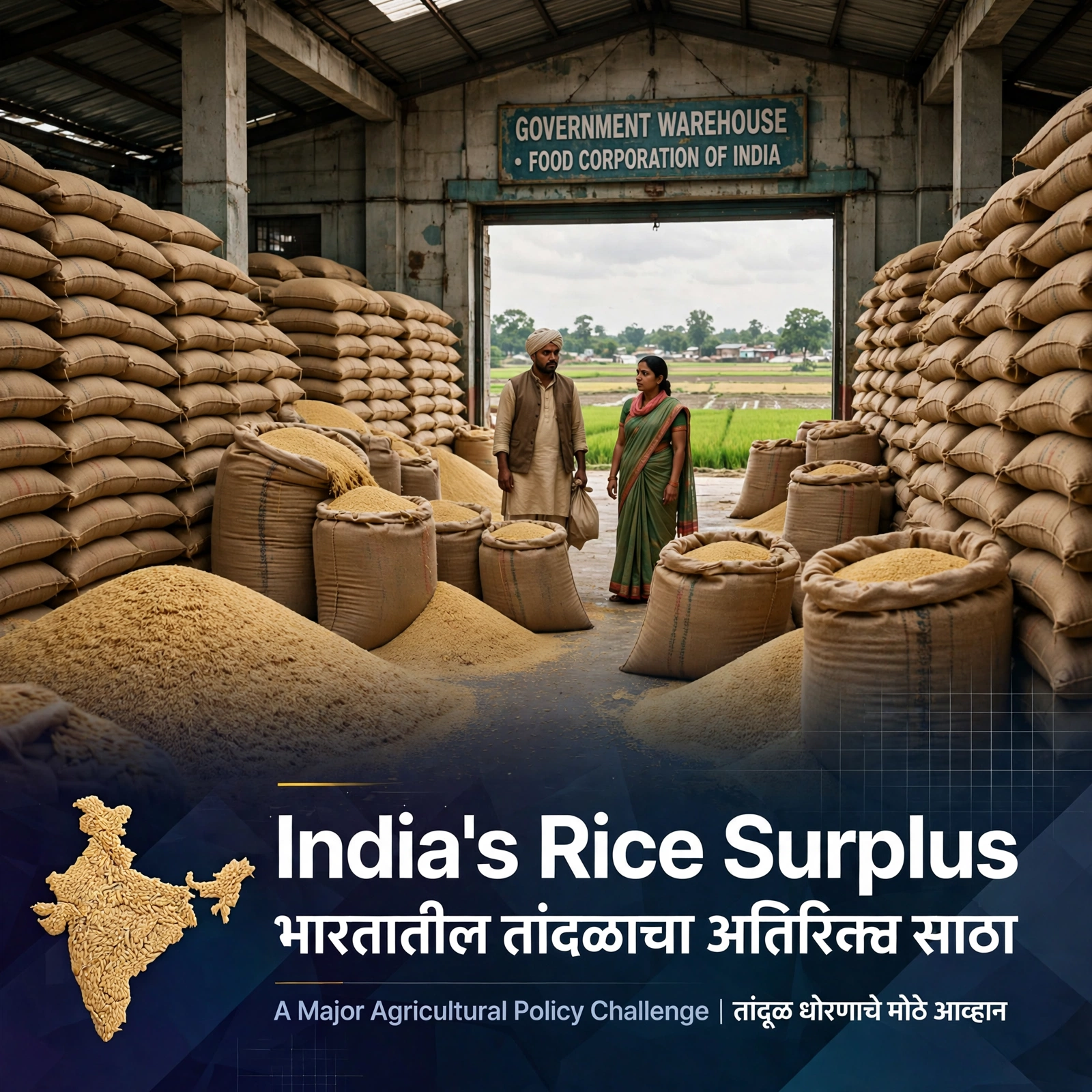
India’s Rice Surplus Creates a Major Agricultural Policy Challenge
India has achieved remarkable success in rice production over the past decade. From overcoming food shortages to becoming one of the world’s leading rice exporters, the country has transformed its agricultural landscape. However, this achievement is now creating a new challenge for policymakers. India’s growing rice surplus is putting pressure on government procurement systems, food storage infrastructure, agricultural subsidies, water resources and farmers’ income.
The country is producing more rice than it needs for domestic consumption, raising important questions about agricultural planning and the future of Indian farming. While higher production reflects improvements in agricultural technology, irrigation, high-yielding seed varieties and government support, excessive dependence on rice cultivation can create long-term economic and environmental problems.
The major challenge for India is no longer simply increasing foodgrain production. It is finding a sustainable balance between agricultural production, domestic food requirements, farmer profitability and international market demand.
India’s Growing Rice Production: An Overview
India is among the world’s largest rice-producing countries and plays a significant role in the international rice market. Improved farming practices, better seed varieties, agricultural research and government procurement policies have contributed to the country’s increasing rice production.
According to recent reporting published in November 2026, India’s rice production reached approximately 154 million tonnes in 2025–26, compared with estimated domestic consumption of around 107 million tonnes.
This significant difference between production and consumption has contributed to a substantial rice surplus.
India has also strengthened its position in international agricultural trade. Its rice exports reached approximately 22.3 million tonnes in 2025, accounting for around 40% of global rice trade.
Although these figures demonstrate India’s agricultural strength, they also highlight the growing responsibility of managing excess production.
The government must ensure that surplus rice is stored efficiently, distributed properly, exported competitively and used without creating unnecessary financial pressure on taxpayers.
Why Is India Producing More Rice Than It Needs?
Several agricultural, economic and policy-related factors have contributed to India’s growing rice surplus.
1. Minimum Support Price Encourages Rice Cultivation
The Minimum Support Price (MSP) is an important government mechanism designed to protect farmers from falling agricultural market prices.
The government announces MSP for paddy before the sowing season, providing farmers with greater price certainty.
Government procurement through agencies such as the Food Corporation of India (FCI) also encourages farmers to continue cultivating rice.
However, when procurement incentives remain concentrated on rice and wheat, farmers may prefer these crops over pulses, oilseeds and other agricultural alternatives.
As a result, rice cultivation can expand even in regions where alternative crops may be more suitable.
2. Improved Seeds and Agricultural Technology
Agricultural research has significantly improved rice productivity in India.
Modern seed varieties, improved cultivation methods, better crop management and agricultural machinery have helped farmers increase production.
Flood-tolerant rice varieties have also supported cultivation in areas that previously experienced considerable production risks.
These technological improvements have strengthened food security but have also contributed to increasing rice availability.
3. State Government Bonuses
In several rice-producing states, farmers receive additional financial incentives over and above the central MSP.
These bonuses can make paddy cultivation more attractive compared with alternative crops.
However, additional incentives may increase procurement requirements and contribute to excess government rice stocks.
Better coordination between central and state agricultural policies is therefore necessary.
4. Limited Crop Diversification
Rice and wheat continue to dominate agricultural production in many regions.
Farmers often hesitate to shift to pulses, oilseeds, millets and other crops because of uncertain market prices, limited procurement facilities and concerns about profitability.
Without reliable market access and financial support, crop diversification becomes difficult.
This creates an imbalance in agricultural production and increases the country’s dependence on rice cultivation.
Major Challenges Created by India’s Rice Surplus
The growing rice surplus is not simply a storage problem. It creates several interconnected economic, agricultural and environmental challenges.
1. Rising Government Storage Costs
Government agencies must purchase, transport, handle and store large quantities of rice.
Maintaining surplus stocks requires warehouses, modern storage facilities, transportation infrastructure and regular quality monitoring.
When government procurement exceeds domestic requirements, storage expenses increase significantly.
Poor storage management can also result in grain deterioration, quality losses and wastage.
The government therefore needs better stock management systems and more efficient distribution mechanisms.
2. Increasing Financial Burden on the Government
Rice procurement involves substantial public expenditure.
The government must finance MSP procurement, food subsidies, transportation, storage and distribution through the public food system.
When rice stocks accumulate beyond operational and buffer requirements, the financial burden becomes more difficult to manage.
These resources could otherwise support agricultural research, irrigation development, farm mechanisation, rural infrastructure and farmer welfare programmes.
3. Pressure on Farmers’ Income
A large rice surplus can affect agricultural markets and prices.
When supply exceeds demand, market prices may experience downward pressure, particularly when government procurement is limited or delayed.
Farmers who depend on private buyers may struggle to receive profitable prices.
Excessive dependence on one crop can also make agricultural households vulnerable to market fluctuations.
Therefore, increasing production alone does not guarantee higher farmer income.
4. Groundwater Depletion and Environmental Concerns
Rice cultivation requires substantial water, particularly when farmers use traditional flood irrigation methods.
In states such as Punjab and Haryana, intensive rice cultivation has contributed to groundwater extraction pressures.
Continuous rice cultivation can also affect soil health, irrigation sustainability and agricultural biodiversity.
The challenge is especially important in regions where water resources are becoming increasingly limited.
Promoting water-efficient cultivation practices is essential for long-term agricultural sustainability.
5. International Trade and Export Competition
India is a major supplier of rice to international markets.
However, depending excessively on exports to manage domestic surplus creates additional challenges.
International rice prices fluctuate according to global production, demand, trade policies, transportation costs and currency movements.
If global prices decline, Indian exporters may face increased competition.
India must therefore maintain competitive export policies while protecting domestic food security and ensuring fair returns for farmers.
How Can India Manage Its Growing Rice Surplus?
Addressing the rice surplus requires a balanced agricultural policy that considers farmers’ interests, consumer requirements, government expenditure and environmental sustainability.
The following measures can help India develop a more sustainable agricultural system.
1. Promote Crop Diversification
Crop diversification is one of the most important long-term solutions.
Farmers should be encouraged to cultivate alternative crops such as:
- Pulses, including tur, moong, urad and gram.
- Oilseeds such as soybean, sunflower and groundnut.
- Millets such as jowar, bajra and ragi.
- Maize and other regionally suitable crops.
However, diversification should not depend only on awareness campaigns.
Farmers need assured market access, competitive prices, procurement support, quality seeds and suitable agricultural infrastructure.
2. Encourage Water-Efficient Rice Cultivation
The government should promote technologies and cultivation practices that reduce unnecessary water consumption.
Important approaches include:
- Direct Seeded Rice (DSR).
- Alternate Wetting and Drying (AWD).
- Laser land levelling.
- Drip and sprinkler irrigation where agronomically suitable.
- Improved water management practices.
These technologies can help farmers reduce water wastage, improve resource efficiency and manage cultivation costs.
3. Improve Rice Storage Infrastructure
Modern storage infrastructure is essential for managing agricultural surpluses. India’s Growing Rice Surplus: Challenges Causes & Agricultural Policy Solutions
The government should continue investing in scientific warehouses, silos, moisture monitoring, pest management and efficient transportation systems.
Better coordination between procurement agencies, rice mills and storage facilities can reduce delays and prevent grain losses.
Digital inventory management can also improve transparency in government foodgrain stocks.
4. Strengthen Rice Export Opportunities
India can use its agricultural production capacity to strengthen its position in global rice markets.
Developing better export infrastructure, maintaining consistent quality standards and exploring new international markets can improve export opportunities.
However, export decisions should consider domestic availability, food security requirements and international trade commitments.
5. Increase the Production and Consumption of Millets
Millets have considerable potential in India’s agricultural diversification strategy.
Crops such as jowar, bajra and ragi can be cultivated in several regions with comparatively lower water requirements than conventional paddy cultivation.
Increasing millet consumption through public awareness, institutional procurement, food processing and nutrition programmes can create additional market opportunities for farmers.
6. Improve Agricultural Market Access
Farmers need more than production incentives to achieve long-term profitability.
Strengthening agricultural markets, farmer producer organisations (FPOs), digital market platforms, food processing facilities and direct market connections can help farmers obtain better prices. India’s Growing Rice Surplus: Challenges Causes & Agricultural Policy Solutions
A stronger agricultural value chain can also reduce dependence on government procurement.
Role of Government Agricultural Policies
Government policy will play a decisive role in managing India’s rice surplus.
Agricultural support systems must gradually move towards a balanced approach that encourages sustainable production instead of focusing exclusively on increasing output.
Recent government interventions demonstrate the growing importance of managing excess stocks.
In November 2026, the government announced an increase in the rice sale target under the Open Market Sale Scheme (Domestic), from 25 lakh tonnes to 50 lakh tonnes for 2026–27.
The government has also introduced mandatory stock disclosure requirements for rice and paddy stocking entities to improve market monitoring and transparency. India’s Growing Rice Surplus: Challenges Causes & Agricultural Policy Solutions
These measures highlight the need for better coordination between procurement, storage, distribution and agricultural marketing.
Future agricultural policies should focus on:
- Improving procurement planning according to actual requirements.
- Supporting farmers who shift towards alternative crops.
- Promoting sustainable water management.
- Strengthening agricultural research and development.
- Expanding domestic and international market opportunities.
- Reducing unnecessary government storage and handling costs.
The objective should be to protect farmers while maintaining an economically and environmentally sustainable food system.
What Does India’s Rice Surplus Mean for Farmers?
For Indian farmers, the growing rice surplus presents both opportunities and risks.
On one hand, strong production and government procurement provide an important foundation for agricultural income and national food security.
On the other hand, excessive dependence on rice can limit opportunities to grow more profitable or regionally suitable crops.
Farmers should carefully consider local soil conditions, water availability, market demand and cultivation costs before selecting crops.
Crop diversification, modern agricultural machinery, efficient irrigation and improved farm management can help farmers reduce production risks.
Access to reliable agricultural information is equally important.
Platforms such as KrushiTools.com can help farmers understand government schemes, agricultural machinery, farming technologies, irrigation methods and available support programmes.
Future of Indian Agriculture: Moving Beyond Rice Production
India’s agricultural future will depend on its ability to move from production-focused policies towards sustainable and market-oriented farming.
Increasing food production remains important, but agricultural development must also consider water conservation, soil health, farmer profitability and changing consumer demand.
Technology will play an important role in this transition.
Precision farming, artificial intelligence, improved seed technology, digital agricultural markets and modern farm machinery can help farmers make better production decisions.
Government institutions, agricultural universities, private companies and farmer organisations must work together to support this transformation.
India has already demonstrated its ability to achieve foodgrain production at a large scale.
The next challenge is ensuring that agricultural production meets actual market demand without creating unnecessary financial and environmental costs.
Conclusion
India’s rice surplus represents both an agricultural achievement and a major policy challenge.
Higher rice production has strengthened national food security and established India as a leading player in the global rice market. However, excess stocks, rising procurement expenditure, storage limitations, water depletion and limited crop diversification require immediate and coordinated attention.
The solution is not to discourage farmers from growing rice. Instead, India needs a balanced agricultural system that protects farmer incomes while encouraging suitable alternative crops, efficient water use, better storage and stronger agricultural markets.
By combining effective government policies, modern agricultural technology and sustainable farming practices, India can transform its rice surplus challenge into an opportunity for agricultural development.
The future of Indian agriculture will depend not only on how much food the country produces, but also on how efficiently, profitably and sustainably it produces it.
Frequently Asked Questions (FAQs)
1. Why is India facing a rice surplus?
India is facing a rice surplus because of increasing production, improved seed varieties, government procurement policies, MSP support and additional state-level incentives. Rice production has grown faster than domestic consumption.
2. What is the impact of rice surplus on Indian farmers?
Excess rice production can create market price pressure, increase dependence on government procurement and discourage crop diversification. Farmers may also face greater risks when they depend heavily on a single crop.
3. How does MSP contribute to rice surplus in India?
The Minimum Support Price provides farmers with price assurance. Combined with government procurement and additional state incentives, it can encourage farmers to continue cultivating rice, contributing to higher production.
4. Which crops can replace rice in suitable agricultural regions?
Depending on soil, climate, water availability and market conditions, farmers can consider pulses, oilseeds, millets and maize as alternative crops.
5. How can India reduce its rice surplus?
India can manage its rice surplus through crop diversification, improved procurement planning, modern storage facilities, stronger agricultural exports, water-efficient cultivation and better agricultural marketing. India’s Growing Rice Surplus: Challenges Causes & Agricultural Policy Solutions
6. Why is rice cultivation a groundwater concern?
Traditional flooded rice cultivation requires substantial irrigation water. Continuous paddy cultivation in water-stressed regions can contribute to groundwater depletion.
7. What is the role of technology in managing agricultural production?
Modern agricultural machinery, precision farming, improved seed varieties, digital market platforms and efficient irrigation technologies can help farmers improve productivity, reduce costs and manage resources sustainably.
For more information about agricultural schemes, farming technologies, subsidies, irrigation methods and modern agricultural machinery, visit KrushiTools.com.