
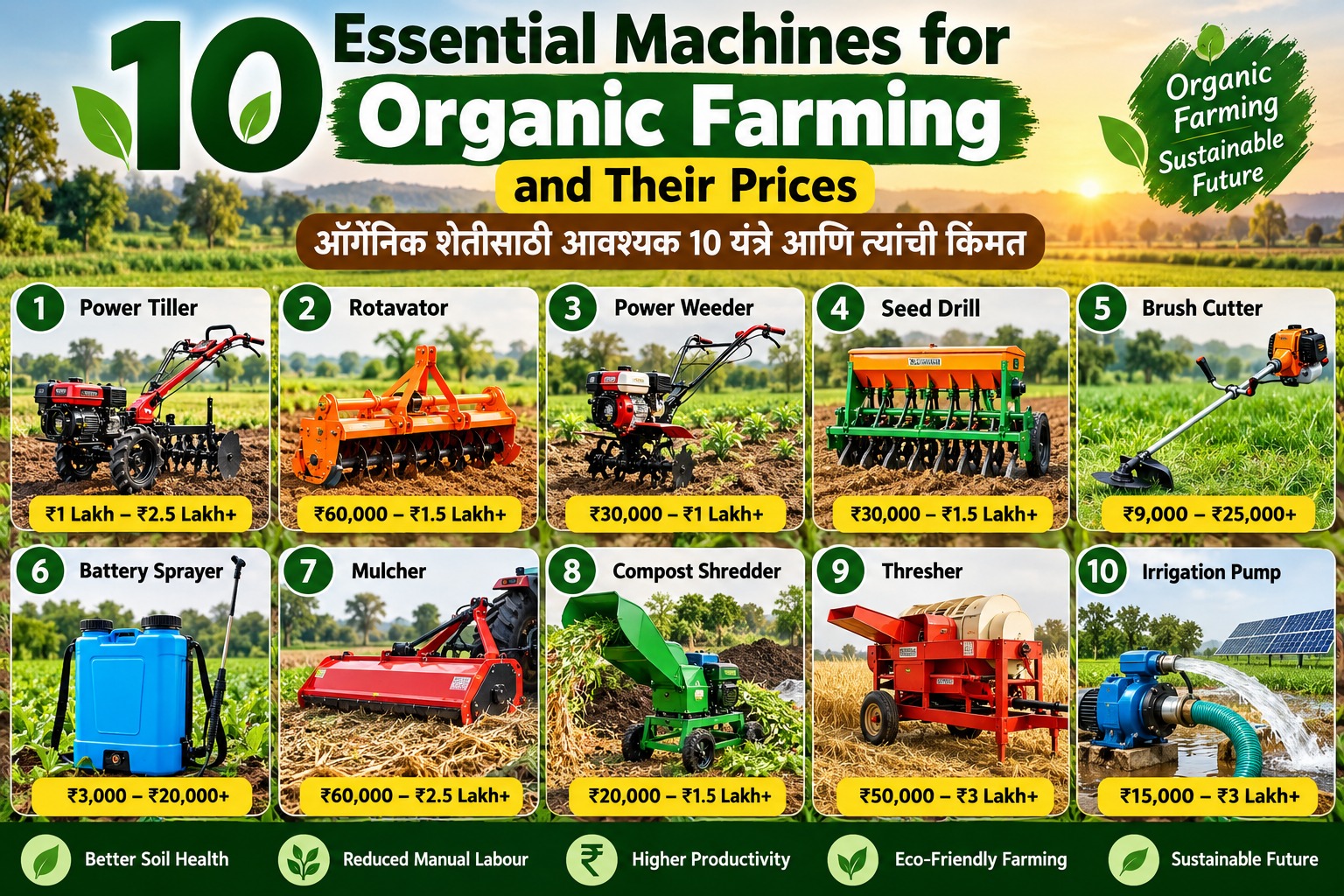
10 Essential Machines for Organic Farming and Their Prices
ऑर्गेनिक शेतीसाठी आवश्यक 10 यंत्रे आणि त्यांची किंमत
Organic farming is becoming increasingly popular among Indian farmers because it focuses on maintaining soil health. Reducing dependence on synthetic agricultural inputs. Recycling farm waste and producing crops through more sustainable farming practices. However, organic farming does not mean that every operation has to be done manually.
Modern farm machinery can help farmers save labour, reduce operating time and complete important agricultural operations at the right time. Machines can be particularly useful for soil preparation, sowing, weed management, compost preparation, spraying bio-inputs, harvesting and crop-residue management. 10 Essential Machines for Organic Farming and Their Prices ऑर्गेनिक शेतीसाठी आवश्यक 10 यंत्रे आणि त्यांची किंमत
In this article, we look at 10 essential machines for organic farming in India, their major uses, indicative prices and the type of farming operation where they can be useful.
Important: Prices mentioned below are approximate market ranges for guidance. Actual prices can change according to brand, model, horsepower, capacity, attachments, dealer, state and applicable government assistance.
Quick Overview: 10 Organic Farming Machines and Prices
| No. | Machine | Main Use | Approx. Price in India |
|---|---|---|---|
| 1 | Power Tiller | Soil preparation & multiple farm operations | ₹1 lakh – ₹2.5 lakh+ |
| 2 | Rotavator | Soil preparation & seedbed preparation | ₹60,000 – ₹1.5 lakh+ |
| 3 | Power Weeder | Weed management | ₹30,000 – ₹1 lakh+ |
| 4 | Seed Drill / Zero-Till Drill | Seed sowing | ₹30,000 – ₹1.5 lakh+ |
| 5 | Brush Cutter | Grass and weed cutting | ₹9,000 – ₹25,000+ |
| 6 | Bio-Input / Battery Sprayer | Spraying organic inputs | ₹3,000 – ₹20,000+ |
| 7 | Mulcher / Shredder | Crop-residue management | ₹60,000 – ₹2.5 lakh+ |
| 8 | Compost / Chaff Shredder | Compost and biomass preparation | ₹20,000 – ₹1.5 lakh+ |
| 9 | Thresher | Separating grain from harvested crop | ₹50,000 – ₹3 lakh+ |
| 10 | Irrigation Pump / Solar Pump | Water management | ₹15,000 – ₹3 lakh+ |
Prices are indicative and should be verified with the manufacturer or dealer before purchase.
1. Power Tiller
A power tiller is one of the most versatile machines for small and medium-sized farms. It can be used for soil preparation and, depending on the model and attachments, can support operations such as cultivation, puddling, planting and other field activities.
For organic farmers, a power tiller can be useful where tractors are difficult to operate because of smaller field sizes or narrow farm boundaries.
Main uses
- Soil preparation
- Cultivation
- Seedbed preparation
- Inter-row operations with suitable attachments
- Puddling in suitable crops
- Transport and other operations with compatible implements
Approximate price
₹1 lakh to ₹2.5 lakh or more, depending on horsepower, transmission, attachments and manufacturer.
Government agricultural machinery references list different subsidy and cost norms for power tillers, while actual market prices depend on the model and specification.
Who should consider it?
Power tillers can be useful for farmers with small and medium-sized holdings, vegetable farms, horticulture farms and farms where a full-size tractor may not be practical.
2. Rotavator
A rotavator is a tractor-mounted implement designed to break and mix soil and help prepare the seedbed. 10 Essential Machines for Organic Farming and Their Prices ऑर्गेनिक शेतीसाठी आवश्यक 10 यंत्रे आणि त्यांची किंमत
It can reduce the number of separate tillage passes required in some farming systems. However, excessive tillage can affect soil structure, so organic farmers should use a rotavator according to soil condition and their overall soil-management plan.
Main uses
- Seedbed preparation
- Soil pulverization
- Mixing crop residues
- Secondary tillage
- Preparing land before sowing
Government agricultural machinery information lists rotavators among commonly supported farm implements, with costs varying according to specifications.
A current agricultural machinery reference gives a broad indicative range of approximately ₹60,000–₹1.5 lakh for rotavators, while specific models can cost more.
Tip for organic farmers
Do not select a rotavator only because it produces finely pulverized soil. Consider soil moisture, soil structure, crop-residue management and minimum-tillage requirements before every operation.
3. Power Weeder
Weed management is one of the major challenges in organic farming because farmers generally avoid relying on synthetic herbicides.
A power weeder can help control weeds mechanically between crop rows and in suitable field conditions.
Main uses
- Inter-row weeding
- Vegetable crop maintenance
- Orchard weed management
- Soil loosening around suitable crops
- Reducing manual weeding requirements
A government agricultural machinery page lists power weeders among agricultural equipment supported under mechanization assistance, while agricultural machinery references show different price ranges depending on type and power.
Approximate price
₹30,000–₹1 lakh+
Smaller machines may cost considerably less, while heavy-duty machines with additional attachments can cost more.
Best suited for
- Vegetable farming
- Horticulture
- Row crops
- Small and medium farms
4. Seed Drill / Zero-Till Seed Drill
Good seed placement is essential for achieving uniform crop establishment.
A seed drill places seeds at controlled spacing and depth. A zero-till drill can sow certain crops without conventional seedbed preparation.
ICAR information describes zero-till seed drills as equipment used for direct sowing in appropriate field conditions. It also reports time and sowing-cost savings compared with conventional seedbed preparation in specific cropping situations.
Main uses
- Wheat sowing
- Pulses
- Oilseeds
- Cereals
- Multi-crop sowing with suitable equipment
Approximate price
- Basic seed drill: ₹30,000–₹45,000
- Seed-cum-fertilizer drill: ₹45,000–₹70,000
- Zero-till drill: ₹70,000–₹1 lakh+
- Advanced multi-crop/pneumatic models: ₹1 lakh–₹1.5 lakh+
Market references show that prices vary significantly according to row configuration and technology.
5. Brush Cutter
A brush cutter is a compact machine used to cut grass, weeds, small vegetation and unwanted plant growth.
For organic farms, it can be particularly useful because mechanical vegetation management can reduce the amount of manual labour required.
Main uses
- Grass cutting
- Weed cutting
- Farm-boundary maintenance
- Orchard maintenance
- Clearing vegetation around fields
Approximate price
₹9,000–₹25,000+
The price depends on engine type, engine capacity, shaft design, brand and attachments.
A current Indian farm-machinery price reference places typical brush-cutter prices broadly around ₹9,200–₹18,500, although premium models can cost more.
6. Battery Sprayer or Bio-Input Sprayer
Organic farming can involve the application of biofertilizers, botanical preparations, biopesticides and other permitted farm inputs.
A battery-powered sprayer can make spraying easier and reduce manual pumping effort.
Main uses
- Bio-input application
- Botanical spray application
- Foliar nutrient application
- Pest-management sprays
- Small-farm crop protection
Approximate price
₹3,000–₹20,000+
Small 16–20 litre battery sprayers are generally at the lower end, while higher-capacity or motorized spraying systems cost more.
A current 2026 machinery price reference lists 16–20 litre battery sprayers in a broad range of approximately ₹2,840–₹5,200 for typical models.
Important
Always use only inputs permitted under the applicable organic certification standard or farming system being followed. Organic farming does not mean that every naturally derived product is automatically permitted.
7. Mulcher / Crop-Residue Shredder
Crop residues can become an important resource in sustainable and organic farming.
A mulcher or residue shredder cuts crop residues into smaller pieces. Depending on the farming system, these residues may then be retained on the field, incorporated appropriately or used as biomass.
Main uses
- Crop-residue management
- Straw chopping
- Orchard vegetation management
- Mulching
- Preparing biomass for further decomposition
Approximate price
₹60,000–₹2.5 lakh+
The actual cost depends on working width, tractor requirement, blades, capacity and manufacturer.
ICAR research published in 2026 has documented the use of machines such as mulchers, Happy Seeders and Super Seeders for crop-residue management and conservation-oriented farming systems.
Organic farming benefit
Proper residue management can help return organic matter to the soil and reduce the need to remove or burn crop residues.
8. Compost or Biomass Shredder
Compost is an important component of many organic farming systems. Farm waste, crop residues and other suitable biomass can be processed to make decomposition easier.
A shredder can reduce the size of plant material before composting.
Main uses
- Chopping crop residues
- Preparing biomass
- Compost preparation
- Processing farm waste
- Preparing material for faster decomposition
Approximate price
₹20,000–₹1.5 lakh+
Small electric or compact machines may be relatively affordable, while commercial biomass shredders can cost substantially more.
Who needs it?
This type of equipment can be particularly useful for:
- Organic vegetable farms
- Fruit farms
- Dairy-linked farms
- Commercial compost producers
- Farmer groups and FPOs
9. Thresher
After harvesting, farmers need to separate grain or seed from the crop. A thresher performs this operation mechanically.
Depending on the machine, threshers may be designed for specific crops or multiple crops.
Main uses
- Grain separation
- Wheat threshing
- Pulse threshing
- Oilseed processing
- Seed preparation
Approximate price
₹50,000–₹3 lakh+
Price depends on capacity, crop compatibility, power source and automation.
For a small farmer, purchasing a large thresher may not always be economical. Custom hiring or sharing machinery through an FPO or farmer group can be an alternative.
10. Irrigation Pump or Solar Water Pump
Water management is extremely important for organic farming.
A suitable irrigation pump can help farmers move water from a well, borewell, pond or storage system to the field.
Solar pumps can reduce dependence on grid electricity or diesel where site conditions and system economics make them appropriate.
Main uses
- Drip irrigation
- Sprinkler irrigation
- Farm water pumping
- Vegetable irrigation
- Orchard irrigation
- Water storage management
Approximate price
- Small electric pump: ₹15,000–₹40,000+
- Higher-capacity agricultural pump: ₹40,000–₹1 lakh+
- Solar agricultural pump systems: ₹1 lakh–₹3 lakh+ or more, depending on capacity and installation
The total cost of a solar irrigation system depends on pump capacity, solar panels, controller, mounting structure, installation and other components.
How to Choose the Right Machine for Organic Farming?
Buying expensive machinery is not always the best solution. Farmers should select equipment according to their farm size, crop, soil type, labour availability, terrain and annual usage.
Before purchasing a machine, consider these factors:
1. Farm Size
A 2-acre farmer may not need the same equipment as a 50-acre commercial farm.
For smaller farms, compact machines such as:
- Power weeders
- Brush cutters
- Battery sprayers
- Small shredders
may be more practical.
2. Crop Type
Machinery requirements differ for:
- Vegetables
- Fruits
- Cereals
- Pulses
- Oilseeds
- Sugarcane
- Plantation crops
Choose equipment specifically suited to your crop.
3. Labour Availability
If labour is expensive or difficult to find during peak agricultural operations, mechanization can help complete work on time.
4. Machine Maintenance
Before purchasing, check:
- Spare-parts availability
- Local service centre
- Warranty
- Fuel or electricity consumption
- Availability of trained operators
- Cost of replacement parts
5. Tractor Compatibility
For tractor-operated implements, check:
- Tractor horsepower
- PTO requirements
- Hydraulic capacity
- Working width
- Weight of implement
Do not purchase an implement without checking whether your tractor can safely operate it.
Should Small Farmers Buy or Rent Agricultural Machinery?
Not every farmer needs to purchase every machine.
For expensive equipment such as:
- Rotavator
- Mulcher
- Seed drill
- Thresher
- Super Seeder
- Large shredders
custom hiring can sometimes be a practical alternative.
Farmers can also consider:
- FPO machinery sharing
- Farmer groups
- Custom Hiring Centres
- Local agricultural machinery rental services
This can reduce the initial investment while still providing access to mechanization.
Government Subsidy for Agricultural Machinery
The Government of India operates agricultural mechanization support through programs including the Sub-Mission on Agricultural Mechanization (SMAM) and state-level mechanisms.
The official DBT Agriculture Machinery portal states that government assistance is provided to support farmers in procuring agricultural machinery, with implementation involving central and state governments and other stakeholders.
The official agriculture machinery portal also publishes information concerning cost norms and financial assistance.
However, subsidy percentages, maximum assistance, eligibility, approved machinery and application procedures can differ by state, farmer category, machine and financial year.
Therefore, farmers should check the current official state agriculture department or DBT agriculture machinery portal before making a purchase decision.
Which Machine Should You Buy First?
There is no single machine that is suitable for every organic farmer.
A simple approach is:
For a small vegetable farm
Consider:
Power weeder + brush cutter + battery sprayer + irrigation equipment
For a cereal or pulse farm
Consider:
Power tiller/tractor + seed drill + weed-management equipment + thresher
For an orchard
Consider:
Brush cutter + power weeder + sprayer + shredder/mulcher
For a commercial organic farm
Consider:
Power tiller/tractor + rotavator + seed drill + mulcher + sprayer + harvesting/threshing equipment
Frequently Asked Questions
What machines are useful for organic farming?
Useful machines include power tillers, rotavators, power weeders, seed drills, brush cutters, sprayers, shredders, mulchers, threshers and irrigation pumps.
What is the cheapest machine for organic farming?
Small battery sprayers and brush cutters are generally much less expensive than tractors or large agricultural implements. Prices vary by model and manufacturer.
Can machines be used in organic farming?
Yes. Organic farming can use mechanical equipment. The important consideration is how the machine is used within the farm’s organic production and soil-management practices.
Is a power weeder useful for organic farming?
Yes. A power weeder can help control weeds mechanically and reduce manual labour, particularly in suitable row crops, vegetable farms and horticulture.
What is the price of a power tiller in India?
A power tiller can cost approximately ₹1 lakh to ₹2.5 lakh or more, depending on horsepower, manufacturer, attachments and specifications.
What is the price of a rotavator in India?
A rotavator can broadly cost around ₹60,000 to ₹1.5 lakh or more, depending on working width, tractor compatibility, brand and features.
Is there a subsidy on agricultural machinery?
Government and state agricultural mechanization programs may provide financial assistance for eligible agricultural machinery. Eligibility and assistance vary by state, farmer category, machine and financial year. Check the official agricultural machinery portal before applying.
Should farmers buy machinery or rent it?
For expensive machines that are used only a few times each season, renting, custom hiring or sharing machinery through an FPO or farmer group may be worth considering.
Final Thoughts
Mechanization can make organic farming more efficient without changing the basic principles of sustainable agriculture. The right machinery can help farmers manage soil preparation, sowing, weeds, crop residues, compost materials, irrigation and harvesting while reducing dependence on manual labour.
However, farmers should not purchase machinery simply because it is available. The best equipment depends on farm size, crop, soil, labour availability, annual usage and budget.
Before purchasing any machine, compare at least three factors: purchase price, operating cost and expected annual usage. Also check local service availability and whether any current government assistance is available.
For farmers looking for agricultural machinery, equipment information, farming tools and related agricultural resources, KrushiTools can be used as a starting point for researching available options.
Always verify the latest machine price, specifications, warranty, dealer support and government subsidy eligibility before purchasing. 10 Essential Machines for Organic Farming and Their Prices ऑर्गेनिक शेतीसाठी आवश्यक 10 यंत्रे आणि त्यांची किंमत